|
|
TECHNICAL INFO
|
FUEL EFFICIENCY
 |
Our
efforts in reacting to the probability of increased cost of fuel
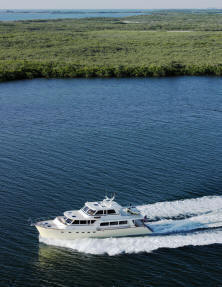
has been a relentless pursuit of technology resulting in yachts
that are roughly twenty percent lighter than a single skin solid
laminate of materials normally seen
in “heavy”
displacement yachts. |
We
embrace Kevlar and other highly engineered fabrics specifically designed
to absorb the loading seen on board a yacht on any sea. We further
refine that technology by infusing a SAN foam sandwich, resulting in an
I-Beam like cross section of the hull laminate. To maximize the enhanced
strength characteristics of this virtually bullet proof technology, we
utilize modified epoxies that are matched to the strength of the
individual fibers selected. It would be of little or no value to
laminate these exotic high strength fabrics with a common polyester
resin whose ultimate yield strength is only a fraction of the
surrounding fabrics. In other words, the resin would fracture and fail
long before the enormous strength of the fibers was utilized.
By embracing this advanced technology, we are able to reduce the weight
per square foot of laminated area significantly, while producing a
laminate far more rigid than a common single skin of roving, chopped
strand mat and polyester resin. Were one to design a single skin
laminate equal in strength to sandwich construction, the weight of the
total laminated component would be several times that of cored
construction utilizing today’s materials and technology. In lieu of
attempting to build such an outrageously thick laminate with its
attendant liabilities, most manufacturers reduce the unsupported panel
size by elaborate stringers and framing to reinforce the physically
weaker panel. This leads further into the rapidly escalating domino
effect of more weight, less usable volume for a given size and a much
more restrictive layout choice due to the need for additional framing,
bulkheads and gussets, to say nothing of the loss of valuable sound and
vibration dampening the sandwich construction brings.
Since fuel usage is directly tied to the mass that must be moved, all
things being equal, it behooves us to reduce unnecessary weight wherever
possible. In so doing, the canoe body draft can be and is reduced by
simple immersion data; e.g. for each 64 lbs of additional weight on
board, one cubic foot of immersed surface must be added to carry it.
Other benefits that are part and parcel of the quest for lighter
structures are the automatic lowering of the center of gravity of the
yacht. Weight above the center of gravity of a yacht could never be
described as a benefit under any condition. Since the center of gravity
on a well designed yacht fifty or so feet in length is typically only
3-5 feet above the design water line, a bit of simple mathematics shows
us the detrimental effect of raising the center of gravity. In comparing
a heavy solid laminate that has been unequivocally shown to be weaker
for a given laminate schedule compared to a cored one, the
superstructure with its large amount of framing can weigh up to 50% more
than a modern cored structure. This additional weight must be carried by
the propulsion system at higher horsepower and therefore additional fuel
cost. To further evaluate the effect of older technology still in use,
if the center of gravity is raised by only one foot, a very serious
reduction in form stability results. Our own data suggests that much or
all of the original economy achieved by the rounded sections can be lost
if additional active stabilization is required for comfort, since active
stabilizer fins work by throwing a large fin in counter to the water
flow past the yacht. This motion adds significant drag to the
displacement trawler, with the figure increasing significantly as the
sea conditions increase.
Since the righting moment created by the combination of heavy
superstructure and round sections is compromised, the normal tactic is
to load the bilge with iron or lead to act as a counter to the heavier
superstructure and topsides. Once again the domino effect rears its
head, requiring more draft to support the ballast and more horsepower to
keep it underway.
 The
subject of ballasting a yacht is one that can provoke a lively
point-counterpoint by those fully versed in the dynamics of roll moment
and the pendulum effect. An example of that argument can be found in the
disastrous Fastnet race where more than one dozen fine sailors as crews
on ocean racing yachts were lost due to the complete rollover of their
vessels. It is interesting to read the findings of the investigative
committee regarding the frequency and severity of the capsizes. The
conclusions reached were that even though the yachts were fully
ballasted, the loss of the mast by violent winds or wild gybes virtually
guaranteed capsizes. The obvious inference being that despite the
enormous ballast far below the center of gravity, without the
stabilizing effect of the mast to act as the pendulum so to speak, the
yachts were not as stable as if they were constructed without ballast.
That evidence certainly gives one cause to carefully consider a heavy
topside opposed by thousands of pounds of ballast. If one can simply
reduce the weight of the topside while increasing its strength
dramatically by more advanced engineering and materials, it would be
difficult to make a plausible argument against doing so, other than
economy. It is interesting to note the rapid move of US and other world
government’s militaries to advanced composites or far lighter metals in
superstructures of virtually all new ships. Reduced fuel costs, greater
armament against enemy attack by utilizing higher technology and vastly
increased comfort for the men and women who man the posts aboard. I am
not aware of any new military designs underway today that embrace the
full displacement theme. In fact quite the opposite, we see more and
more Wave Piercer technology being introduced due to increased
comfort, seaworthiness and economy of operation. I suspect that if
heavy, deep and slow were viable concepts, our battle fleets would be
made up of Bismarck like battleships typical of WW11 in lieu of the
Arleigh Burke Frigates being launched routinely at Bath Iron Works. The
subject of ballasting a yacht is one that can provoke a lively
point-counterpoint by those fully versed in the dynamics of roll moment
and the pendulum effect. An example of that argument can be found in the
disastrous Fastnet race where more than one dozen fine sailors as crews
on ocean racing yachts were lost due to the complete rollover of their
vessels. It is interesting to read the findings of the investigative
committee regarding the frequency and severity of the capsizes. The
conclusions reached were that even though the yachts were fully
ballasted, the loss of the mast by violent winds or wild gybes virtually
guaranteed capsizes. The obvious inference being that despite the
enormous ballast far below the center of gravity, without the
stabilizing effect of the mast to act as the pendulum so to speak, the
yachts were not as stable as if they were constructed without ballast.
That evidence certainly gives one cause to carefully consider a heavy
topside opposed by thousands of pounds of ballast. If one can simply
reduce the weight of the topside while increasing its strength
dramatically by more advanced engineering and materials, it would be
difficult to make a plausible argument against doing so, other than
economy. It is interesting to note the rapid move of US and other world
government’s militaries to advanced composites or far lighter metals in
superstructures of virtually all new ships. Reduced fuel costs, greater
armament against enemy attack by utilizing higher technology and vastly
increased comfort for the men and women who man the posts aboard. I am
not aware of any new military designs underway today that embrace the
full displacement theme. In fact quite the opposite, we see more and
more Wave Piercer technology being introduced due to increased
comfort, seaworthiness and economy of operation. I suspect that if
heavy, deep and slow were viable concepts, our battle fleets would be
made up of Bismarck like battleships typical of WW11 in lieu of the
Arleigh Burke Frigates being launched routinely at Bath Iron Works.
On the subject of economy, while there can be no argument that a well
designed full displacement cruiser can, even with the liabilities
mentioned, achieve greater fuel economy in a very narrow speed range,
compared to the best semi displacement designs, this economy is rapidly
lost if the captain finds the lower speeds to be inadequate. A well
designed full displacement cruiser will achieve outstanding economy at
Speed/Length ratios of roughly 1.1 times the square root of the water
line length. If we assume a 58’ yacht has a waterline length of 49’, we
find a square root of seven. Multiplying 1.1 times seven yields a real
cruising speed of 7.7 knots. Any attempt to increase that speed runs
afoul of a rapidly increasing resistance curve that can easily triple
fuel consumption for a modest one or two knot increase in speed. An
attempt to exceed a Speed/Length ratio of more that about 1.34 times the
square root of the waterline length ( 9.38 knots) causes the full
displacement design try and climb its bow wave, which it cannot do due
to laws of physics, no matter how much power is applied. Even at S/L
ratios of 1.25, a very substantial fuel penalty is incurred.
Considering all the above and numerous other factors such as the
apparent shortage of leisure time our modern lifestyles have afforded
us, it is our opinion that a more middle of the road design is a better
choice. By careful design of the underwater appendages and canoe body
shape, together with a meaningful weight study and advanced construction
techniques, we can achieve fuel economy remarkably close to the full
displacement design if we choose to operate the vessel in Speed/Length
ranges of 1.1 or thereabouts. If we are willing to pay the additional
costs or time dictates, we also have the advantage of speeds in the
twenty knot range with comparatively modest horsepower. If we are
willing to pay even more, we can easily power the yacht with larger
horsepower offerings, taking the speeds up into the thirty knot range.
Beyond this general area, other design modifications should be
considered, as the resistance curve of the semi displacement hull for we
have designed becomes less efficient compared to a flatter, more “hard”
section shaped yacht.
In weighing all these factors and carefully considering the average
number of hours the typical owner will use their yachts over a period of
years, it is not difficult to see the time advantage versus relatively
minor cost tradeoff that most have chosen.
What will the future bring?
In our view, the increased cost of fuel coupled with the unlikely luxury
of more time will cause slight adjustments to current hull design
resulting in reduced skin friction to enhance a yacht’s “slipperiness”
through the water. A softening of the chines will provide some of this
gain with relatively minor reduction in inherent stability. Further
technological gains in structural strength for a given weight will allow
the reduction of waterline beam, providing still more gains. Engine
manufacturers will join the fray by continuing to improve B.S.F.C.
Development of alternative methods of electricity production will reduce
the required fuel to produce a Kilowatt of energy, driving the cost down
even more.
|