|
With
a fleet of yachts as exciting and innovative as the Marlow Explorers, it
is no wonder that there is a large collection of Magazine articles
featuring these fine yachts. Read some excerpts and then check the
publication on-line or contact Marlow Yachts for a reprint of the
article.
2011
October
2011 • BoatTEST.com •
The new Marlow 97 E (for "Euro") was
introduced last winter at the Miami Boat Show and is the largest boat
built so far by Marlow Yachts.
We have seen many motoryachts this size
and it is for that reason that we think the Marlow 97E will be a new
benchmark for affluent cruising yachtsmen who want a motoryacht, but
also want to go most anywhere in it.
Read the entire article and test results by clicking on the link below.
http://www.boattest.com/Partners/Partner-Main.aspx?lp_id=3211624&t=BOAT-TEST&Videoid=2619&p=3&s=
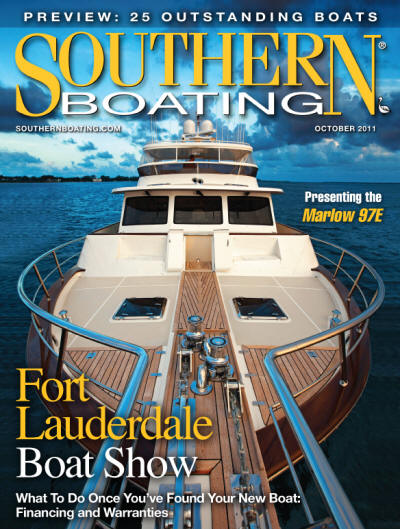
October 2011
• Southern Boating • It's not Magic -
It's a Marlow • by Chris Caswell with photos by Billy
Black (see cover photo above)• It was fitting that the debut of the Marlow
97E should have been at the 2011 Miami International Boat Show, because
that is where David Marlow first dipped his toes into the boating arena
with a 65 footer just 10 years ago. In these few years, Marlow Yachts
has not just established itself as a as a world-class builder of
cruising yachts, but the company has raised the bar for the industry in
many areas of design and construction, as well as for its
ecologically "green" conscience.
The Marlow 97 shown on these pages is
actually Hull #2 and, as such, is a significant departure from the first
yacht. I have to admit that I loved the first 97, with its huge on-deck
master suite where most builders put the pilothouse, and I enjoyed the
enclosed skylounge that doubles as the pilothouse. Being able to step on
deck directly from the owner’s suite, or soak in a hand-carved marble
bathtub while looking out at the world, is hedonism usually reserved for
the yachts of Russian oligarchs.
But then I saw Hull #2 and, once again, it was love at first sight. Step
into the saloon and the vista sweeps all the way to the very bow without
a bulkhead. And the owner’s suite is a private getaway spanning the full
beam in the very center of the yacht for the least motion. The bridge?
Protected by a fiberglass hardtop but wide open from the helm to a boat
deck large enough for a fleet of water toys… or perhaps it was designed
to host Dancing with the Stars.
Good-looking and built to exceedingly high standards, the Marlow 97E
enjoys the kind of performance that is only a dream to most builders.
Whether you’re looking for a long-range cruiser, a weekender for family
and friends or a liveaboard yacht, put the Marlow 97E on your short
list. For his first entry into the Century Club of yachts, David Marlow
has done it with his usual élan.
To read the entire article and see the
many photos click on this link:
http://southernboating.com/blog/2011/10/04/new-boat-marlow-97e/
September 28, 2011
• BoatTest.com • A web-based
Newsletter reviewing yachts and marine items features the largest Marlow
Explorer to date, the 97E. Click on the link to see this review and join
for future newsletters.
www.boattest.com Marlow97
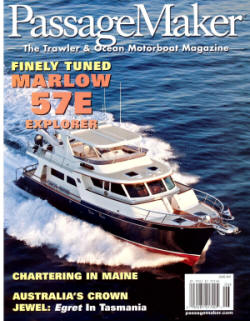
June 2011 • PassageMaker
• Marlow Explorer 57E • by Chris Caswell with photos by Billy
Black • Like all Marlow yachts, the 57E has benefited from
David Marlow’s constant tinkering. After building 32 of the Marlow
53-57’s, David just had to start fiddling. The first result was a
reduction in drag by making subtle changes in the hull design. Next he
made the prop pockets more efficient allowing a drop in the reduction
gearing from 2.5:1 to 2:1. The size of the props for the engines in this
boat provide a good balance between economy and performance.
 At one point, we were moseying along at 8.6 knots and 900 rpm using just
4gph. Total! Pull the throttles of the Cat C18’s back to 700 rpm, and
you are sliding along a just a freckle under 7 knots. While consuming a
gallon per hour. Uno. Eins. One. At that rate, it would take a cruise of
9,642nm to empty the standard tanks. At one point, we were moseying along at 8.6 knots and 900 rpm using just
4gph. Total! Pull the throttles of the Cat C18’s back to 700 rpm, and
you are sliding along a just a freckle under 7 knots. While consuming a
gallon per hour. Uno. Eins. One. At that rate, it would take a cruise of
9,642nm to empty the standard tanks.
This Marlow 57E can hustle along at just under 30knots. At higher
cruising speeds, I found she has a sweet spot around 2000-2100 rpm,
giving her speeds in the 23-25 knot range using just 70 percent power
for long engine life.
The fact remains that this well-found craft offers speed when you need
it, economy across a wide performance range, and the reliability and
comfort you’d expect in a luxury cruising yacht.
Click on this link for a video of the 57E
http://www.youtube.com/user/marlowsales?feature=mhum#p/a/f/0/Eo6AwosN-4Q
April 2011
• Showboats International • Irish Rover
by Marilyn Mower with photos by Scott
Pearson • It has been 10 years since Marlow Yachts debuted at
the Miami Boat show. This year, the yard introduced the 97E, its first
yacht with an overall length of 100 feet. A series of deliberate steps
brought David Marlow to this moment.
“I was approached a number of years ago by a customer who really wanted
me to build him a hundred-foot Explorer, but I wasn’t ready, and I told
him I wouldn’t take his money just to experiment,” says Marlow. “We had
a lot of things to learn to do first.” Two things were chief on that
list: Improving hull efficiency and improving composite construction.
Going farther and faster on less fuel is his end game.
His design doodles, equations, and experiments to develop the twin keel
concept fill volumes but boils down to this: The strut keels exit the
underbody of the hull in line with the engines aft of amidships at about
the point at which the deadrise begins to morph into tunnels. The keels,
a NACA foil shape, work like feathers on an arrow directing the flow of
water. They aid in tracking, create lift in the after section when the
yacht heels, dampen pitch, flatten the stern wave, and reduce parasitic
drag by enclosing the rotating propeller shaft for most of its length.
They also protect the propellers from debris and groundings.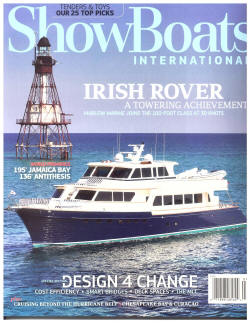
In 2009 Marlow Yachts won an NMMA Innovation Award for its Full Stack
Infusion-a proprietary lamination process where the entire hull is
infused with resin in one hour. The magic occurs inside a fully enclosed
mold using extreme vacuum. Infusion saves time (the traditional lay-up
method took 36 days for a 78 footer), and 3 barrels of resin (translate:
weight!)
The final part of making sure he was ready for a 100 footer was to
achieve certification by ABS, Lloyds Register (A Ocean Class), ISO 9001
and, finally, Bureau Veitas unrestricted navigation.
David Marlow’s search for optimal solutions-and the fact that he
incentivizes his yard workers to innovate-is revealed in detail upon
detail; a hundred little links in the chain that have led, on this day,
to Irish Rover.
January 2011
• Southern Boating • Stem to Stern
-Marlow's Big Boat - Times Two
• David Marlow, Chairman of Marlow Yachts, is quite a
prolific thinker, and most of the time he's thinking about his yachts
and how to build them better. It pays off - each time he launches a new
model, it is always fresh and innovative. David's latest launch, the
Marlow 97E, is his biggest yacht yet and it doesn't disappoint. The
second 97E is on it's way to the US and will feature an open bridge with
a hardtop while the one here has an enclosed command bridge.
2010
May 2010
• Power & Motoryacht • The Next Generation-Companies
that are leading the recovery
• Marlow Yachts is positioned for
phenomenal growth of brand awareness and value in 2010 with the
introduction of three new models. In February, Marlow introduced the
latest Prowler design in the Havana Series, setting new standards in
center console sportfishermen with the capability to reach Mexico from
Florida nonstop. Marlow Yachts' new line of semidisplacement Voyager
models can venture farther, faster and with lower fuel consumption while
providing a more stable and comfortable ride compared to any
full-displacement cruiser of similar size. In October of 2010, Marlow
Yachts will introduce its largest craft to date, 97' LOA. This exciting
yacht is able to reach speeds of near 30 knots with C-32 Caterpillars, a
feat no yach tof her size has accomplished.
www.powerandmotoryacht.com/marlow
May 2010
•
SeaMagazine
• A
New Yacht, A new Challenge
•
David Marlow had a plan. He wanted to build a long-range yacht that
could cross any ocean without refueling, but had to make the crossing at
faster speeds than conventional long-range yachts, and it had to keep
its occupants comfortable. The end result of years of shipbuilding and
refinement is the Marlow Voyager 76LR, which debuted at the Miami
International Boat Show in February 2010.
Marlow is so
confident in his latest vessel that he has concocted a contest, dubbed
the Ocean Challenge. Marlow has asked his fellow builders to put their
longest range cruisers in the water at West Palm Beach, FL, this summer
and race to Reykjavik, Iceland- a distance of roughly 3,900 miles- using
only the fuel in the yachts standard tanks.
He sees it as a
harkening back to the days when yachtsmen engaged in such competitions
on a regular basis. Plus, he really likes being on the water. Click on
the link below for the complete article.
SeaMagazine.com
The Ocean
Challenge
March/April 2010
• Ocean (Australia) •
Marlow Declares War with new Voyager •
Marlow Yachts launched the Voyager 76LR motor yacht at the Miami
Boat Show while also launching an aggressive promotional campaign
against the makers of full-displacement motor yachts. According to
Marlow, the Voyager series has the ability to cross any ocean nonstop at
speeds claimed to be 30 percent greater than today's round bottom
passagemakers. "Full displacement shapes are not the most economical or
seaworthy shapes available, as this new range will go where they cannot
go in comfort, economy and safety they cannot achieve while exhibiting a
style far beyond the high, boxy and cumbersome shapes often seen".
Marlow said today's passagemakers typically rely on grossly oversized
stabilizers, iron ballast and excessive draft to counter their very high
centers of gravity, rendering many of the world's most exotic ports,
coves and harbours out of the question. Their typically slow speeds
limit daylight passages to 50-70 miles.
In
an invitation specifically singling out Grand Banks, Fleming, Nordhavn,
Selene, Ocean Alexander, Out Island, Outer Reef, Krogan and Offshore
Yachts, Marlow dared them to join him in a 3,900 mile offshore odyssey
from West Palm Beach, Florida, to Reykjavik, Iceland., to let the "jury
of the sea" decide which boat is the fastest and most economical for
long range cruising. (see
The Marlow Challenge
for more information)
February 2010
• Sea Magazine
• by Capt. Tom Serio Marlow Explorer 72 A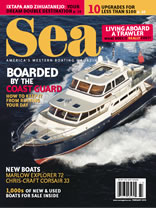 Practical Cruiser
with Down Home Beauty • When you look at a Marlow Yacht, and in
this case the Marlow Explorer 72, you get the distinct sense that not
only has David Marlow built a beautiful, practical yacht but he's done
his homework. The eye-catching simulated lapstrake hull (reminiscent of
days gone by) and the down-home styling of this yacht aren't often seen
today. But under all the beauty is solid design and engineering. Practical Cruiser
with Down Home Beauty • When you look at a Marlow Yacht, and in
this case the Marlow Explorer 72, you get the distinct sense that not
only has David Marlow built a beautiful, practical yacht but he's done
his homework. The eye-catching simulated lapstrake hull (reminiscent of
days gone by) and the down-home styling of this yacht aren't often seen
today. But under all the beauty is solid design and engineering.
For the complete
article and photo gallery, click on the link
www.seamagazine.com/marlow
2009
November 2009
• Southern Boating • Marlow's Bold Venture •
We are used to Marlow Yachts showing up at boat shows with a new wrinkle
or two, now it seems the builder is reinventing the genre in one large
step and simultaneously throwing down the gauntlet.
In 2010 Marlow Yachts will introduce a series of yachts that David
Marlow says will render heavy displacement cruisers obsolete. At
February's Miami Boat Show, Marlow will introduce a Voyager 76LR that
the builder says has the ability to cross any ocean nonstop at speeds 30
percent greater than today's round-bottom, full displacement vessels.
The new Voyagers will be built to "Unlimited Navigation" classification
and have the ability to cruise non-stop from West Palm Beach to
Gibraltar or San Diego to the Line Islands at "speeds not attainable by
any other power yacht on earth today under 120 feet", says David.
Following his formula, the same cruisers wanting to make daylight
passages only will be able to run 100 to 140 miles before dark. The 76's
overall height is 15 to 25 percent lower than the current crop of
offshore cruisers. Part of the innovation is new underwater profile and
part is the adaptation of water ballast technology.
July 2009
• Southern Boating
• The Real Miz
Scarlett by Marilyn Mower
• (This
article is not only about the new Marlow 78 but about her feisty owner,
our own steel magnolia, Mary Ann Bonsey) Mary Ann's first Marlow was
a brokerage Marlow 70 which she bought as soon as she saw it- even
before consulting her banker or lawyer! She is now the proud owner of a
new Marlow 78 which she built with a layout perfect for her lifestyle.
She likes to dine out hence a large desk and office area in lieu of a
dinning room table; she prefers dock-hopping rather than anchoring out
hence the four-wheeled tender - a painted-to-match Smart Car
convertible! Marlow create a carbon fiber and stainless steel platform
for the car with a bridle to lift it off and on using the deck crane.
Carbon fiber box beams were designed and built into the deck to
distribute the weight of the car and crane avoiding external supports.
The upper deck has a large sit down bar for eight bracketed by misters
for cooling. There is nothing shy and retiring about either of these
Southern Belles!
The Real Miz Scarlett
July 2009
• Power & Motoryacht
• by
Capt. Bill Pike How does a
Solar Boat Perform? While our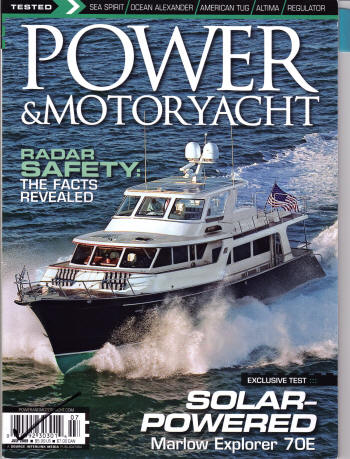 Mark II 70E's speeds were approximately
the same as those we've measured for similar models with the same
1,001-bhp Caterpillar C18 ACERT twin diesel power-plants, she was
generally more fuel-efficient and quieter (sound levels were recorded at
the lower helm station) and posted significantly higher range numbers,
most likely due to her relatively light-weight, high-tech construction
and efficient hull form. Moreover, the 70 tracked like a train (thanks
to a partial keel as well as Marlow's prop-and-propshaft-protecting
strut keels), even in the Manatee River (where we did our speed runs),
despite the fact that soundings of 12 and 16 feet predominate. Mark II 70E's speeds were approximately
the same as those we've measured for similar models with the same
1,001-bhp Caterpillar C18 ACERT twin diesel power-plants, she was
generally more fuel-efficient and quieter (sound levels were recorded at
the lower helm station) and posted significantly higher range numbers,
most likely due to her relatively light-weight, high-tech construction
and efficient hull form. Moreover, the 70 tracked like a train (thanks
to a partial keel as well as Marlow's prop-and-propshaft-protecting
strut keels), even in the Manatee River (where we did our speed runs),
despite the fact that soundings of 12 and 16 feet predominate.
The solar array
itself is an optional addendum rendered almost invisible by its
low-profile location on the hardtop. Each beefy aluminum-framed panel in
the eight panel array is roughly 3'x5', mechanically interlinked with
the others, and capable of an approximate 175-watt maximum output for
roughly 1,500 watts, well over the 1,400 watts the 70 typically consumes
while underway, according to Marlow.
For the complete
review, test and photos please go to
http://www.powerandmotoryacht.com/marlow
March 2009
• Go Boating (Australia) •
Cover Photo of Marlow Explorer 65C
• Cruising Heavyweights • A review of the three dominant brands
of passagemaking yachts in Australia including the Marlow Explorer 65.
This article sets out the similarities and differences in the three
brands with lots of detail, photos and examples.
»Back
to top
January 2009
• A story of
David Marlow's round trip from Florida to Nova Scotia in a 72E Long
Range cruiser •
Northbound
Voyage of the REBEL YELL:
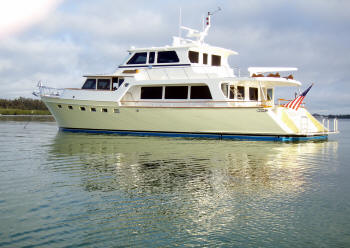 The location I
am writing this article from requires much more than a simple boat, as
the water depth beneath me to the Cape Hatteras canyon floor is more
than two miles. I am on a heading of 41 degrees magnetic, about 250
miles northeast of Cape Hatteras Light en route to Nantucket Shoals,
some 600 miles ahead. It is the fifth day of this non-stop passage, with
about 1200 miles in our wake thus far. The last land sighted was Mantanilla
Shoals, a small barren sandbar about one hundred miles
northeast of Fort Lauderdale as we exited the Florida Straits almost
four days ago. We have just passed through the worst of a very large,
severe weather system that formed along the eastern side of the mountain
ranges of North Carolina on Saturday.It continued building into an intense low
pressure system that swept across eastern North Carolina wreaking havoc
before emerging into the Atlantic around Hatteras Inlet, then building
in strength and pyrotechnics over the warm Gulf Stream waters. Around
midnight we found the most breeze of the trip in this spectacular cold
front moving off North Carolina. Resembling a classic Northeaster
minus a winter storm's ferocity, we saw about 45 knots of breeze for
around two hours. During this period, no one aboard had ever seen such a
display of lightning, our world was similar to living in a disco at
full crank. The rain fell for several hours, with more than three hours of it
at a volume that would sound like a fib if I said it so I will pass.
Suffice to say it was heavy enough to make the top of very large waves
much like the worn round top mountains of eastern Maine. Only a moderate
sea existed on top of the reasonable sized ocean swells, despite a wind
of around forty knots, finally settling to about 25 for the next twenty
four hours. By the time it found us last evening its arrival was long
foretold by continual shipping warning forecasts, Coast Guard
broadcasts, severe weather statements and a late night sky full of
lightning and thunder. Though 46 knots of breeze is not a hurricane, it
is more than enough to cause one to batten down and hope that the vessel
under their feet is truly seaworthy. Since I am now writing this in
brilliant sunlight it bears witness to the fact that REBEL YELL is up to
the task of going to sea, good weather and bad. Though thousands of
lightning bolts pierced the darkness, striking all around us for several
hours, none found their way to our antennas or other electronics. Pretty
advertising photos and marketing materials do nothing out here. The location I
am writing this article from requires much more than a simple boat, as
the water depth beneath me to the Cape Hatteras canyon floor is more
than two miles. I am on a heading of 41 degrees magnetic, about 250
miles northeast of Cape Hatteras Light en route to Nantucket Shoals,
some 600 miles ahead. It is the fifth day of this non-stop passage, with
about 1200 miles in our wake thus far. The last land sighted was Mantanilla
Shoals, a small barren sandbar about one hundred miles
northeast of Fort Lauderdale as we exited the Florida Straits almost
four days ago. We have just passed through the worst of a very large,
severe weather system that formed along the eastern side of the mountain
ranges of North Carolina on Saturday.It continued building into an intense low
pressure system that swept across eastern North Carolina wreaking havoc
before emerging into the Atlantic around Hatteras Inlet, then building
in strength and pyrotechnics over the warm Gulf Stream waters. Around
midnight we found the most breeze of the trip in this spectacular cold
front moving off North Carolina. Resembling a classic Northeaster
minus a winter storm's ferocity, we saw about 45 knots of breeze for
around two hours. During this period, no one aboard had ever seen such a
display of lightning, our world was similar to living in a disco at
full crank. The rain fell for several hours, with more than three hours of it
at a volume that would sound like a fib if I said it so I will pass.
Suffice to say it was heavy enough to make the top of very large waves
much like the worn round top mountains of eastern Maine. Only a moderate
sea existed on top of the reasonable sized ocean swells, despite a wind
of around forty knots, finally settling to about 25 for the next twenty
four hours. By the time it found us last evening its arrival was long
foretold by continual shipping warning forecasts, Coast Guard
broadcasts, severe weather statements and a late night sky full of
lightning and thunder. Though 46 knots of breeze is not a hurricane, it
is more than enough to cause one to batten down and hope that the vessel
under their feet is truly seaworthy. Since I am now writing this in
brilliant sunlight it bears witness to the fact that REBEL YELL is up to
the task of going to sea, good weather and bad. Though thousands of
lightning bolts pierced the darkness, striking all around us for several
hours, none found their way to our antennas or other electronics. Pretty
advertising photos and marketing materials do nothing out here.
In the region
of the eastern and upper Florida Straits I had found a very hot plume of
northward flowing water along the vertical canyon wall and we took full
advantage of its push towards our destination. The worst thing I can
find so far is the loss of that hot plume of water that provided a free
ride, our own version of the Nantucket Sleigh Ride
As we proceeded
northward from the Florida Straits into the Sargasso Sea the breeze had
freshened to about 20 knots, with occasional 22-23 knots and a few
higher puffs. The ocean swells were closer than I would have liked due
to the opposing wind against the stream but the ride was decent. The
wing doors aft sold every man aboard on their value, as the back deck
was a pleasant place to watch the seas and the new moon joining us, the
ocean swells lifting us and dropping us, a cousin close behind to do the
same, each changing the arrangements of diamonds on the sea surface. The
hammock strung from the aft deck overhead was a comfortable place to be
regardless of the breeze.
I had
originally planned to stop in Bermuda for a time but overstayed my time
on my last trip to China, catching a wicked bug that threatened to keep
me ashore. The lure of a few weeks at sea was far stronger and I arrived
back just in time to load a bit of gear and leave around Sundown Tuesday
evening, July 29 for Nantucket, roughly 1800 miles distant. I had flown
to Bermuda for a few days in early July to make arrangements at the
Royal Bermuda Yacht Club, hoping to find time to burn a few days with my
toes in the pink sands while on my way north to Nantucket. But the best
laid plans of mice and men, so often go astray, to paraphrase an earlier
soothsayer. Perhaps on the trip South, I can squeeze in a visit to
Hamilton Harbor, one of my favorites. Since it is mid hurricane season
weather may prevent a visit on this voyage, but hope springs eternal in
those with imagination and a bit of pluck.
Though I
welcomed the boost of the Gulf Stream, I have raced ocean racing
sailboats enough to know that all good things come to an end. During my
trip to Asia just prior to flying home to attend the Nantucket
Rendezvous I had succumbed to the siren song of a new chart plotter
system that did it all, if one just knew how. My main interest was a
purported real time satellite view of the Gulf Stream warmth and
currents. I wanted to know, if intelligent mariners were present just
how much one could expect from Mother Nature in way of freebies in the
form of a favorable current offshore. Over the next 36 hours, the
transparency of marketing versus reality in products came into focus,
with the vaunted system telling me what had happened a few days ago,
displaying historical data instead of real time. Or at least that is my
story for why I found myself at the eastbound end of a Fleur de Lis that
had I chosen to see its branch ending would have brought me all the way
back to about Green Turtle Cay in the Abacos, several hundred miles
behind us. If I had continued to follow that enticing free ride, we
would have turned almost east about 150 miles South of Bermuda and
ultimately nearly due south as the meander played out to join the colder
waters of the north Atlantic.
For about 30
hours we paid the bill, with our new heading now pointed a bit north of
Delaware Bay’s mouth in an attempt to find another of the hot plumes
with northbound currents. During this time the speed was about one knot
below normal, or in this case about 13% with a similarly increased fuel
burn rate due to the Southerly flowing counter current. Eventually,
about two hundred miles northeast of Cape Hatteras, I found a nice
little one knot boost that lasted for 30 plus hours and the mood aboard
ship was improved. Despite the occasional sloppy weather we enjoyed full
dinners and food aplenty for the entire trip with lots of pasta dishes
and healthy stuff to try and guide a bunch of guys who could degenerate
into Cape Cod potato chip gourmets overnight.
We saw
virtually no shipping traffic other than at choke points, as most were
trying to avoid what we were looking for. When they were present it was
duck soup to identify them with MARPA and track them, having benefit of
a continuously updated speed, position and closest point of approach
data at our fingertips.
By this point
in our voyage, the new moon had grown to where each evening, just past
sundown we were treated to a lovely western sky as the moon set not long
after sunset. A ritual of the crew was to lie in the hammock strung
across the rear deck and sway with the ocean’s movements while the sun
or moon went to Asia for the night. Each sunrise was different, some a
burst of light, others a muted display of rose, orange and pink, with a
perfect yellow at a certain moment. None were disappointing watching
them rise a good bit earlier each day as we proceeded north.
Around me the
sea is a blue that surely deserves the description of Cobalt Blue, and
there are flying fish by the dozens sailing downwind away from this
momentary interruption in their domain, the miles clicking off one by
one, our wake soon absorbed into trackless sea that surrounds us.
Long streaks
of golden sunlight shine pathways among the deep swells passing under
us, causing prisms of hued light that my vocabulary cannot hope to
convey. Dragging a long hand line, with a flying fish found on deck at
the other end, a hook artfully hidden in its underbelly may produce the
belly meat of a yellowfin or other tuna soaking in lime juice with
jalapenos, red and green peppers, celery, possibly a touch of Tabasco
soon. And as the first stars rise from the deep blue to the east, the
aroma of the rest of the gift from Neptune seared to perfection on the
aft deck grill ready to compliment a cold glass of wine. Perhaps I have
died and gone to heaven, only to awaken soon and pay the piper. For now,
I am going to contemplate all that has been, all that I know is and some
that could have been or may be yet.
On day seven we
entered the South end of Block Canyon, turning on our fancy bottom
topography software to find and ride north along the vertical wall that
forms its west bank. Rising from around 10,000 feet to ten percent of
that over a small area, the small boost from the northward flowing
current was welcomed. In this area we saw a fair number of commercial
boats, from sword fishermen to tuna boys. As darkness fell, many headed
east towards Montauk, leaving the diehards or multi day workboats to
labor through the night.
As each watch
ends, it is not unusual for a crew member, usually the new watch, to
visit the engine room, donning earmuffs to cancel the C-18s lovely
rumble. As predictably as rain, the remarks afterwards were about how
happy the Cats were and how frugal they were at 1000-1050 with just one
pound of turbocharger boost. Winthrop, being the most derelict of the
three of us, began to lobby for Iceland as our final destination with
gusto; "She’s just a few degrees to starboard", "why matey", he said
more than once while adopting a pirates linguistics, "theys people up
there that have never seen a yacht like this, and "cartain fer sure they
have never seen three finer looking sailors needin a sauna bath with a
brisk rubdown and a tot of rum".
How could I
disagree with such logic?
Duty called
however and at 04:00 we closed with Wasque Shoals South of
Chappaquiddick entering Muskeget Channel. A dragger bound South signaled
us, telling us we looked decent after seven plus wonderful days at sea.
Thirty eight miles to the east lay Brant Point Lighthouse, marking
Nantucket Harbor, where we would drop Bruce in the mud and sand, wash
her down and pour a shot of something to keep the belly bacteria at bay.
As we neared
Nantucket Harbor, a familiar voice on the VHF called to us, welcoming us
to the anchorage. Wayne Turnbull, Jason and his brother had just arrived
from Norfolk on an impressive non-stop performance offshore on their 78’
Marlow ST SOMEWHERE. Wayne is perhaps the most well traveled Marlow
Explorer owner, voyaging offshore almost continuously from Trinidad to
the Bay of Fundy, as he did on his previous Marlow, a 70E.
After a final
inspection and wash down while calculating that we had almost enough
fuel left on board to retrace our steps, I noticed my shipmates
looking toward the lights coming on in Nantucket town. My Asian illness
tolerable, it was not difficult to convince me to launch the Marlow
Sprite tender for our taxi to civilization and a Nantucket Karaoke
session was not out of the question. And that, my comrades of the sea,
is a story for another time.
Nantucket at night was
decent, with some of the gin mills chock a block full. I sang some old
James Taylor stuff with about thirty others (thank goodness for the
camouflage of blending) and reminisced mentally about many of the words
he wrote during difficult periods in his life. The night before the
Rendezvous beginning, I managed to sing a bit with a charming lady
around ninety years of age who played the Baldwin Piano in the bar in a
superb fashion. It has been some time since I sang spontaneously; unable
to suppress a feeling of all is OK, everything is just right. Though
still suffering from some sort of Asian blue bellied crud, I was
delighted to feel the words tumble from me. Please do not take this as
an implication that I can sing with any skill, as even in my shower
songs, I would have trouble carrying a tune in a water bucket.
That evening four fresh
sea mussels with a spot of good cheese melted onto them and a few sprigs
of this and that to doll them up had been washed down with two decent
martinis and a real good barkeep keeping an eye on me. Maybe it was
three.
That I had progressed to
this stage since I left Florida was a small miracle, as the day I
boarded REBEL YELL I felt a malady the likes of which I am not familiar,
and of which I do not want again. To be candid, I did not want to go to
Nantucket at all, to say nothing of more than a week out of touch or
medical help on the open sea.
I caught a small
"feeling punky" ailment about two days before leaving Asia last trip,
roughly seven days before I wanted to slip the lines for Nantucket. But
like the ties and illnesses that could not be exorcised in the story of
"O", the illness proved to be varied, difficult to rid oneself of and
unusual to say the least. Beginning with a small flu like symptom, the
ailment progressed to a small cough in 2-3 days. From there fever came;
hot, near delusionary fever. Chills followed to polish my molars with
the chattering. The cough worsened in a few days, finally becoming
almost uncontrollable at times. Meanwhile the digestive tract decided to
awaken from peaceful sleep and protest vehemently, gathering steam over
a two to three day period a full week after the bug surfaced . The
headaches came, not mind benders for me, but painfully annoying. About
ten days into the illness, the urinary tract said what the heck,
everyone else is exercising, I will too!
By the time I got to
Nantucket, my friends Don Curelli, and Winthrop Yerkes, both hand
selected to do the non-stop with me, were pretty well convinced I was
seriously ailing and tried a small mutiny to force my hand into seeing a
quack. I refused, determined to allow my immune system to learn of this
invader and banish it forever via production of specific antibodies. I
am not sure I could endure it again.
To "get even" with my
intractable position they showed no mercy on me in any way with duties
as a member of the crew. Awarding no "boss’ points", if anything they
went the other way, though in the end as we crossed Nantucket Bar, they
were a bit sleepy eyed from their efforts. Good shipmates they were.
I sent shipmate Don
Curelli home to a relatively new girlfriend he seems to like a lot. Her
name is Lottie and she is a bumpkin from Ruskin, Florida. Lottie was to
join us later for her first boat trip ever, a robust initiation of
approximately 2200 miles offshore nonstop on board REBEL YELL.
Winthrop Yerkes I kept
with me a bit longer for a voyage with a destination of some place, but
no definite route. Halifax was to our right, Eggemoggin Reach a bit to
port. Iceland a bit to starboard and all within our reach without
refueling since Snead Island.
After winding
up the celebration at Nantucket and bidding goodbye to all, I made REBEL
YELL ready for sea again. Since we had just traveled around 1800
nautical miles offshore non-stop, there was not a great amount to do
beyond last minute checks and stowage of miscellaneous gear. Two of us
were aboard for this leg so watches would be a little longer than the
trip from Florida. I had checked the weather forecast, curious about the
reported flight delays from guests leaving the island including one
customer who had chartered a jet to Nassau, Bahamas. The reports were
that the weather to the west of us, in New York State and western
Massachusetts was terrible, causing flight delays and stacking of
aircraft in the corridors around New York-Newark area. On Nantucket the
breeze was as forecast via NOAA weather on the VHF radio; about 5-8
knots southeast and a 3-4’ sea expected off Nantucket Shoals, some 35
miles east of our position.
Our initial
destination was Halifax, Nova Scotia for a day or so, to complete a 2175
mile open sea voyage without refueling, hopefully averaging around 9+
knots. On board fuel was not an issue for the 400 or so miles to reach
Halifax.
Rebel Yell had
been showing off to us in her long range capability at much higher
speeds than one could expect from a pure displacement trawler. At the
same time the ride had been superb due to the firmer bilges and flatter
buttocks lines we originally designed into her. Thus far she was burning
a bit less than nine gallons of fuel an hour including the 25 KW
generator, while delivering an average speed of well over 9
knots. Had we been willing to slow to 8.2 knots, this fuel efficiency
would have increased about 20%.
As we made the
turn at the entrance to Nantucket Shoals, there was a fair swell running
under the port side bow, though the wind was as called for, about 6-10
knots with a 3-5’ sea running on top of the swells. Nantucket Shoals is
a vast area of dangerous shoals that cause large ships and deep draft
vessels to pay attention or go aground. The shoals are littered with
wreckage from groundings and from foundering as well, for when the
breeze is up in a Northeaster, it is a wicked place to be, the seas
breaking in 20-35’ of water depth as it rises from the ocean depths.
That is understandable, as Iceland is the point of land from which the
fetch of the sea builds from. Suffice to say it is able to make good
seamen tighten up a bit.
Proceeding on a
northeasterly course in an attempt to eke out just a little more from a
plume of warm water flowing Northward towards Cape Sable, we noted the
wind slowly rising, the temperature slowly dropping and the seas slowly
building. The last point for checking the weather via VHF would be as we
passed well eastward of Provincetown light, on which there is a very
tall VHF antenna. Once past there, the next bulletins would be issued
when we came within range of Cape Sable, Nova Scotia, To our port side
lay the vast bay of Fundy, where up to 52 foot tides sweep in and out
four times every day. At the head of the "bay", some 600 miles north
lies St John, New Brunswick. At the opening, some 270 miles north of our
position is Yarmouth, Nova Scotia. Eastport, Maine lies about 520 miles
in a north westerly direction.
As the evening
fell, the wind had piped up to around twenty knots and was clocking, in
a familiar pattern exhibited by an early fall Northeaster. The seas had
built to around six feet or a bit more with an occasional rogue coming
by to make REBEL YELL stamp her feet when it slapped the port bow. By
full darkness the wind was around 22 knots with higher puffs and occasional
rain. The wind direction was now just starboard of our bow,
clocking towards the Northeast. We crossed the Boston to Europe shipping
separation lanes without incident, seeing only one large ship bound for
Scotland. There was a decent swell under the wind-blown sea.
Around nine
p.m. I decided to locate my passport after inquiring to be sure my
shipmate Win Yerkes had his aboard and to my dismay found that mine was
not aboard, having been safely secured in another area, some 2000 miles
Southeast of me. After a brief consideration of the likelihood of
talking Canadian Customs into clearing us without a giant hassle, and
possibly an even larger one when re-entering Homeland Security, I
reluctantly plotted a new course for at least a bit of adventure,
feeling a little down that we would not photograph REBEL YELL along
Front Street in Halifax before turning for Orcutt Harbor, Maine, some
450 miles apart.
I have long
wanted to visit a small rock bound island located well off the coast of
Maine in the Bay of Fundy. I had heard tales of its stark beauty from an
artist who lived there for a time, taking sustenance and motivation to
paint from its bare and rocky landscape accompanied by surrounding seas
that roar for several months per year. Its name is translated as "The
Far Away Place" in the Penobscot Indian language. Its name is Matinicus
Rock and only about eighty hard people live there permanently in
clapboard houses anchored by steel pins to the barren granite landscape.
There is no store, no roads, and no coffee shop. A person must be happy
in their own skin to live there. There are about fifteen to twenty
people who do not work in the traditional field of lobstering or
commercial fishing. These few are artists, writers or perhaps souls in
need of a break from humanity as one might find it on the mainland. My
pulse quickened a step as I thought of the adventure of crossing one
more place off my list, which is still far too long to accomplish unless
I can find a miracle. A course alteration of around eighteen degrees,
when the strong incoming tide was factored would take us to Matinicus
Rock, where in theory a reliable light would guide us through an area of
granite shoals that no mistakes are permissible.
The pilot
charts, Ocean Passages for the World and other sources of information on
remote locations describe it reasonably well, giving mariners warning of
the outlying and surrounding dangers, while also warning that the
residents of Matinicus feel no obligation to be friendly to visitors or
for that matter give you the time of day. They also refer to their great
seafaring tradition, mentioning in so many words that a sailor in
distress could be in worse places if help was truly needed. The
implication was that the islanders have lived and learned in an often
times hostile environment that takes few prisoners to care for.
During the
night, visibility deteriorated to under 400 yards, with heavy fog at
times, near constant rain and winds of about 25 knots. They sea was
not especially large and the enclosed bridge a wonderful and cozy
environment as we averaged about 9.5 knots across the bottom. Around
02:30 a large and very fast ship being carefully tracked on both radars
altered course to port, immediately signaling our RADAR plotting aid
that the closest point of approach was a big problem, varying from an
optimistic 100 yards to zero. Neither was an acceptable interval for two
vessels closing at speeds of over 35 knots so we altered course to
starboard to pass well behind the very large and fast target growing
rapidly on the screen. For reasons unknown to me, the ship also altered
course so as to pass only about 300 yards to my port side. A further
move to starboard by me brought a tandem move by the helmsman on board
the mystery ship. Standing by to open the throttles while reversing
course when a preset guard zone distance was penetrated, I watched the
courses converge rapidly with no visual sighting. My best calculation
showed the ship would pass only 300 yards to port of me if no further
course alteration was taken. All deck lights and both searchlights were
illuminated in case the ships RADAR was inoperable, though I could not
imagine such high speed operation in essentially zero visibility.
Onward the
target came, maintaining approximately the same heading until her lights
became visible through the thick sea fog and light rain. Ultimately
passing some four hundred yards South of us, with only a few dim deck
lights I could not determine what she was or her intended destination,
having altered course several times to avoid such close encounters.
After passing roughly abeam of us at four hundred yards, she made a
ninety degree course alteration to starboard, showing me her stern
lights and ranges indicating a large seagoing vessel. My assumption is
that she was military, as soon her speed increased to around thirty
knots on a course of almost due South.
We saw no more
traffic, though fog, rain and sea conditions may have obstructed modest
sized vessels from our view. Soon a faint echo of Matinicus Rock, where
the reliable light was purported to be began to echo on the long range
RADAR. At 04:00 we stood off the entrance to Matinicus Harbor in a
sobering gray pre dawn light punctuated by the sounds of breakers to
port and starboard where the chart called out names like Hogshead rock
and so forth. The Ocean Passages manual describes Matinicus Harbor as a
very small harbor of refuge in foul weather, the exception being when
the wind is in the Northeasterly quadrant. Precisely where the 25-28
knots of breeze we felt resided at that point.
After standing
off and observing a decent echo of what appeared to be the harbor
entrance on both RADAR units and hearing a faint bell to starboard,
where it should be, I lit both searchlights and eased ahead with just
enough steerageway to keep good control in the following seas entering
the harbor, hoping the foul predawn would keep any commercial fishermen
in bed or at least in port a bit longer. In an attempt to identify the
bell, my course was drawn to bring us close aboard in hopes of
identifying it precisely. Sure enough, we drew abeam of it, clanging
loudly in the somewhat boisterous channel to the harbor and verifying we
were indeed on course.
Matinicus
suffers no fools for long, with a harbor only about 150 yards wide and
400 yards long. The central part is open to the Northeast and once
inside a decision must be made and acted upon to turn to starboard, or
to port. Failure to do so will engage the bow pulpit with a one mile
long and eighty feet high chunk of granite there since the earth cooled.
A yacht or ship will meet an awful fate should she be swept against the
headland when any sea is running. As if to point out how risky it was to
be there in the center a fine looking yawl of around 60 feet in length
had all her chain and anchors out towards the entrance, her stern only
about 100 feet from the granite headland. The hapless yachtsmen on board
had apparently entered the harbor before the wind built and shifted to a
dangerous quadrant during the night. It was not a pretty sight as fairly
often the anchors would hold her bow down and a sea would sweep her
decks back to the dodger before running back over the coamings. I took
special care to bring REBEL YELL to starboard, hoping to find a place a
bit more protected, though the growing light did not show much.
While standing
off the headland, holding my position and surveying, I noted a small
boat being launched from a low spot along the headland with two
thoroughly soaked men clambering aboard, first rowing to get clear and
then starting a Yamaha outboard. My shipmate Win remarked that they must
have some sort of emergency, as no one in their right mind would choose
to go boating, especially in such a small craft under the conditions.
The small boat
assumed a course for us, with the visibility improving enough to see the
bowman waving to us to come to his position. After observing what was
obviously excellent seamanship handling the small vessel I began a slow,
in place turn to point my bow at them. As I approached, they gestured to
follow them towards the opposite end of the harbor, once again crossing
the open roadstead where the pitching and diving yawl was anchored
tenaciously to what surely was a rocky bottom.
The course took
us to the very Southwestern end of the harbor, roughly 50 yards South of
the open mouthed entrance. Upon arrival the bowman on board the small
craft alternated between bailing the small boat furiously, to pointing
at what appeared to be a lobster pot float on our bow. Placing the small
boat inside a tiny crevice in the rock behind the rough opening, he
gestured for us to pick it up, indicating it was a mooring line attached
to something on the bottom. After two passes in difficult conditions it
became obvious that Win could not retrieve the small pot alone and I
could not risk bringing the stern close enough to allow him closer
access, for fear of fouling the propellers; a disaster in waiting for
certain.
In a heroic act
of seamanship, the helmsman of the small boat steered to where the
bowman could grab the pot buoy and pull it inside the boat with him,
revealing a short piece of ¾" pennant attached to an object unknown. I
could not see him, his mate or their vessel when closer than about
twenty five feet due to the height of the bow on REBEL YELL but as is
often the case a good dose of my Irish luck was handed to me, as I saw
Win reach far outward to grasp the pennant and pull it through the hawse
pipe. With some difficulty he made it fast to the bow cleat and I let
REBEL YELL settle back against the line to test its strength. Finding it
firmly attached to some stout object, I walked out on the boat deck to
survey how close we could swing to a very large granite headland marking
the Southeasterly edge of the harbor entrance. I descended the ladder to
the cockpit to find two grinning Matinicus Rockhounds, thoroughly
soaked, now seated in a half awash boat taking a bit of refuge from our
windward position compared to them. As we spoke, introducing ourselves
to Joshua and Lucas Black, they noted that if we could get a long stern
line to another buoy about fifty feet away we could warp her stern
around into what was a comparative lee. All for it, we strung together a
couple of one inch dock lines, passing them to Joshua in the bow. In a
couple of minutes he had made the bitter end fast and the stern thruster
moved the stern into a fine position to relax a bit.
Coming close
aboard in their now half filled boat, Joshua bailing to keep ahead, I
invited them aboard for some breakfast and coffee. Lucas declined, with
Joshua issuing a forlorn look, saying the missus had it all prepared for
them by now up the hill. Refusing to take money, they made a salutary
circle around REBEL YELL, pronouncing her as they came by the stern
again, the purtiest thing to ever visit their rock.
After a few hours of rest and fluid checks we were underway again,
bound for Orcutt Harbor Maine, where I have a small cottage and mooring.
Arriving without incident on a gorgeous Maine evening, we picked up the
mooring pennant and Rebel yell settled back against the one inch nylon
rode. A fuel check revealed 1300 gallons of fuel aboard still, enough to
turn south and go to Jacksonville, Florida before a fuel stop would be
necessary. The ships log reflects an average speed for the entire
northern leg of 9.65 knots.
Last night,
with a snoot full of good rum in me I lay on the deck of REBEL YELL and
looked up at the far northern sky. The stars on a clear night there are
indescribable, with all the polar stars clearly seen. The atmosphere is
so clear there appears to be ten times the number that we see down South
where light and air pollution detract from the view. They are familiar
to me, as I use them to navigate and as a backdrop to dream by. I
watched satellites pass overhead and the occasional shower of a small
meteor, resembling a major Fourth of July exhibition. I tried to find
just which one of the billions of stars is my lucky one. Maybe all of
them are. Maybe this ride around the ball I have been blessed with is
really just heaven, and I have the great blessing of seeing it all
without dying so far.
In roughly
three weeks we will slip the mooring line and head REBEL YELL South,
retracing our steps, against the Gulf Stream this time, a distance of
roughly 2100 miles. And that too, is a story for another day.
Voyaging South:
In the previous
segment of this article I spoke of the offshore voyage north on REBEL
YELL, the Marlow 72ELR that I have owned for about two years now. The
voyage began from a few miles up the Manatee River off Lower Tampa Bay
and headed South for roughly 240 miles before intersecting with the
eastward flowing Gulf Stream in the Florida Straits between Cuba and the
Florida Keys. From there a sharp turn port was taken for approximately
180 miles and then a gradual turn to port until the course was nearly
Northeast for a landfall with Wasque Shoals and Nantucket Sound, for a
total leg of around 1700 miles. Passing close to Bermuda allowed us to
grab the plumes of hot water flowing all the way from the Amazon Basin,
onward to Scotland and curving Southward to the Canaries, and across to
the lower Caribbean. From there another 400 plus miles were logged in
the Maritimes and finally to a mooring in the Bay of Fundy.
REBEL YELL is a
72’ Marlow Explorer with the Command Bridge option. The "E" designation
in the model name refers to the shape of her transom, designated
"European". LR indicates she is a Long Range version of that series.
The long range
series has several different features when compared to the 72E. The
primary one being the Wave Piercer Bow, which is often mistakenly
referred to as a Bulbous Bow. Wave Piercer technology is quite different
and far more effective compared to a common bulbous bow. In fact I have
never been able to quantify a performance gain with a bulbous bow until
around 85’ in length. Before that, I find a performance loss and
increased pitching moment created by the somewhat crude appendage
referred to as a bulbous bow. It is my strong opinion that all the hype
about bulbous bows is exactly that until the yacht reaches a waterline
length able to take advantage of its small contribution to hydrodynamic
flow.
The Wave
Piercer is totally different in concept and result and is the result of
various governmental testing programs whose purpose was to enhance the
seagoing ability of a yacht under the majority of sea conditions and
increase its speed with a given horsepower setting. It is as different
as day is to night in how it works on the canoe body (hull) of a yacht
or ship. On REBEL YELL, it enhances ride and low to mid range
performance, giving up a very slight amount of speed at wide open
throttle (less than one half knot) in return for roughly 5 percent
higher speed at lower throttle settings and the attendant increase in
fuel efficiency.
On the voyage
from Tampa Bay non-stop to Nantucket and then onward without refueling
to the waters of Nova Scotia, Matinicus and Bay of Fundy, we had, for a
considerable part of the northbound voyage a favorable current that we
had plotted and utilized to speed us along. The trip South would be
later in the season, with frost each night along the Bay of Fundy and
snow in the higher elevations. It would also be against the north
flowing Gulf Stream current so it would be a good test of our long range
ability under more adverse conditions. Every opportunity to find the
least adverse currents would be taken and any maverick countercurrents
would be latched on to for a free ride. Finding them is a different
matter as there are no announcement signs.
Upon arrival in
Orcutt Harbor, just off Penobscott Bay, Maine, at the end of the
northbound leg I had moved from the luxury of REBEL YELL’S comforts to
the woods of Maine and immersed myself in a month long diet of herbs
roots, berries, ferns, teas and all manner of purging elements. I cannot
say that I felt deprived in any way, as I came to enjoy all the delicate
flavors of things previously unknown. I did not complain about what the
bathroom scale revealed either, with 15 lbs of desk slab gone from my
frame. In this time I tried concoctions of my own, freelance style and a
variety of herbal goodies, Oriental wisdom and Native American lore. I
can say that the only one that was completely unpalatable was a tea I
made from Birch Bark I peeled from a young sapling. It was positively
jaw locking. On balance I re-established that I can get along pretty
well without suffering in most any environment. Among my favorites was
to make a delicious snack from pine nuts toasted in a piece of foil
placed next to a small fire mixed with wild blueberries gathered from
Norumbega Mountain. I was thoroughly enchanted by my time there but as
each night became colder, and October upon us I knew it was time to say
goodbye to the woods and waters of the Maritime Provinces and States.
One brilliant
fall day I maneuvered REBEL YELL alongside a small lobster boat float
placed for the benefit of local lobstermen to unload their delectable
cargo onto waiting trucks. Available only at high tide due to the 12-14’
tidal range in the small cove, we made arrangements for a local heating
oil company to bring their tanker truck filled with diesel and carrying
120 feet of hose to stretch down the steep incline of the shore and
ramp, just reaching our amidships position fills. It is good that the
yacht’s tanks fill from either side, as not one inch of extra hose
remained when stretched out with the transom close to a granite
outcropping that rose more than two hundred feet above us.
Exiting the
narrow, winding and rock laden channel to the dock the sky overhead
revealed a change in weather brewing with high mare’s tails forming. The
weather forming was not one normally expected this far north. There was
a hurricane coming and as Murphy would absolutely dictate, it was coming
there and at the prescribed time we had intended to leave for a 2150
mile open sea voyage to Florida’s west coast. Not such a wonderful
thought to contemplate and only a fool would consider going anyway in
the teeth of even a fairly minor hurricane of 100 knots, as Kyle was at
that moment.
I returned to
the 6000 lb block of granite buried deeply in the mud of Orcutt Harbor
and maneuvered REBEL YELL so that the mooring pennant could be picked
up, the eye placed on the beefy forward cleats and allowed the yacht to
settle back against the tackle in the two knot current flowing under her
keel. After a brief consideration I decided to test the tackle and
mooring quality and reversed the engines to approximately 1200 rpms,
finding it to be a solid as the Rock of Gibraltar, able to ride out most
blows without concern. That evening Kyle came by, the eye passing about
60 miles east of our mooring. Though a sea story could be formed I
suppose, in truth the cove was so well protected by small mountains that
little notice was given to this wayward tropical system.
The next
morning under gray skies we slipped the mooring located at 45 degrees,
eight minutes and sixty nine seconds North Latitude and sixty eight
degrees, 30 minutes west longitude bound for Tampa Bay, just over 2100
miles distant. We made a salutary circle of the harbor with the Kahlenburg air horns echoing off the mountains, and then setting a
course of 196 degrees magnetic. If I had calculated the tidal stream
correctly, this would carry us down the Bay of Fundy with a free ride,
though roller coaster like. By the time we exited the mouth of the 150
mile wide bay, amusement park roller coaster sized swells lifted us high
in the air and carried us low into the deep valleys of the swells. The
wind was light by this time and the large swells spaced well apart
allowing the yacht to ride up their slopes and down without much fuss or
discomfort. The laboring of the big Cats in the bilge as we would begin
the ascent of the swell and the subsequent free ride down the back side
was mesmerizing as we proceeded Southeast at a bit over eleven knots to
pass eighty miles east of Provincetown, Massachusetts, located on the
northeastern tip of Cape Cod.
An adverse
tidal current met us east of Provincetown and we endured a two knot
north flowing current racing to fill the Bay of Fundy’s northern reaches
where the tidal range is as great as 52 feet, four times a day. During
the evening leftover squalls from Kyle visited us and gave the boat a
decent rinse. As we crossed the Boston to Europe Ship Traffic Separation
lanes a few large ships were observed heading for Europe after waiting
out the hurricane in safe harbors. One very large passenger liner, lit
as a small city dipped her deck lights to us in passing salute.
Daylight came
and revealed a mixture of gray with occasional blue skies appearing as
the weather sorted itself. By mid day it appeared that we could ride a
tidal gate westward through Nantucket Sound however the upset weather
had altered the normal flow of ocean currents and upon arrival we found
the tide racing Northeast across the vast Nantucket Shoals region that
stretches for fifty miles. Though the water is typically 35 to 200 feet
in depth for a long way offshore, the leftover swells from Hurricane
Kyle caused the waves to break in spectacular fashion as a shallow spot
of 30-50 feet was encountered. The appearance of the huge combers
reminded me of those seen on the North Shore of Oahu where surfers
gather to ride their steep faces at breakneck speed. To make matters
worse, the tidal gate had been altered by the Hurricane and we would
face an adverse current for approximately sixty miles. These adverse
currents required me to raise the rpms of the C-18 Cats to maintain a
speed of roughly 10 knots so it would provide a varied exercise of speed
versus fuel burn when studied.
Around sundown
we found a small countercurrent flowing to the Southeast generally
toward Long Island Sound and rode its scimitar shaped flow as long as
possible, picking up a full knot and allowing engine loads to be reduced
while making good way. The evening passed quickly with the three hour
watch system, the skies clearing to reveal the Fall sky and its
travelers throughout the night. Orion, ever the Hunter patiently stalked
the seven lovely sisters of Pleiades, who flirtatiously allow him to
view them through the evening before passing beyond the horizon. In
Block Canyon where water depths are more than two miles, a few sword
fishermen and mid water trawlers worked in the calm seas with the
heavens above mirrored in the deep blue below us. For about 6 hours that
evening the phosphorus in the water reflected every movement of every
creature and allowed me to hang over the bow and study the fluid motions
of the shape I had drawn for REBEL YELL. A wonderful test tank that gave
a perfect image of the hydrodynamic forces at work on a hull slipping
peacefully through the realm of Neptune.
The marine
traffic thinned considerably after passing roughly two hundred miles
east of New York City with the weather fine and the temperature climbing
rapidly once the Labrador Current was put behind us. Finding a
noticeably warmer plume of water that had a small Southbound eddy with
it I altered my course to 168 degrees true, which would, if I continued
carry me close to Bermuda on this Southbound leg. Well aware that it
would abandon us at some point I studied bottom profiles and played
hydraulic flow games in my mind to try and imagine how the vast
northward flowing river of the Gulf Stream would react to the canyon
walls, undersea mountains and continental shelf edges. There are some
pretty good clues as to its normal behavior over the eons, with the most
obvious one being the extreme depths it has carved into canyon floors.
But those clues refer only to the historical data and history is formed
of much more than the tidy end result. The third day came and went, as
did the fourth, the weather giving a moderate breeze of 15-20 knots and
seas of six feet or less on a moderate Atlantic swell.
For thirty six
hours I chuckled as I watched the GPS award us a free knot of speed and
reduced engine rpms, knowing full well there would be a bill to pay
somewhere further South. As we neared the latitude of Bermuda the eddy
became more sporadic and our speed reduced with no free ride. With a bit
of chagrin I altered course to cross the Gulf Stream, hoping to close
within 60 miles of the US mainland somewhere South of the South Carolina
border to avoid the strongest current that races around and past Cape
Hatteras.
Life on board
was as pleasant as one could imagine, with plenty of naps, reading time
and absolutely trouble free performance on the northbound and Southbound
legs. It was customary to celebrate the sundown off our starboard bow
each day with a noggin of rum, limited to one shot to assure alert watch
standing. Meals were varied, delicious and the scene around us always
lovely to contemplate. I felt no urge to end this offshore odyssey,
settling into a routine that was satisfying and stimulating, my body’s
motions one with the boat under my feet.
As we crossed
the northward flowing stream the shipping traffic increased in both
volume and type with an occasional sailing yacht spotted with rail down,
a big Genoa drawing well as the breeze carried them South with us.
Speaking with one, a 58’ Boothbay Challenger, we learned that he had
left Martha’s Vineyard two days before us, had enjoyed a fine sail with
good breezes and was bound for Havana, Cuba. I placed my order for a
case of Havana Club "siete ano" sugarcane rum that to date I have not
had the pleasure of receiving. Perhaps he will need rescuing from the
clutches of Hedonistic Havana?
As his
tricolored masthead light receded into the night behind us we approached
a familiar brand of Southbound Trawler yacht at sixty two feet in length
on a similar course with her flopper stoppers in action to reduce the
roll from the beam sea. Speaking briefly by radio, I learned he had left
Bermuda two days prior and was ready for the seas to abate and the
rolling to reduce. Soon, his lights were behind us and fading as he
matched our course to close with the Coast and endure the least area of
the expected three knot adverse Gulf Stream current.
On the fifth
day a small bird landed on deck at a point 350 miles from land in any
direction. Colored brightly on his chest and of the wren family this
small stowaway immediately began to peck his way into being a full time
crew member and receive a free ride South for the winter.
While off watch
and checking a variety of items I noted the small creature following me
around, seemingly quite unafraid and interested in whatever I was up to.
While changing a bulb in a courtesy light on deck, I felt him land on my
shoulder, where he took up residence for as long as I would permit it.
Curious as could be, he inspected my beard, my ears, hair and hands,
completely without trepidation. In the past, when still a fully fledged
vagabond I have had animals as diverse as coons and a goat decide they
wanted to be my best pal but most wild birds have remained aloof. Not
this pint sized voyager! He is the second avian visitor to my inner
realm, as a small bird has taken up resident in a nacelle by my picture
window at my apartment in Chi Hu, Fujian, China. I am not sure what that
means, though I can see fertile grounds for thought.
Since our new
mascot was now coming and going as he pleased, often flying off for
several hours before returning home, the aft door was left open to the
salon and the Command Bridge so that he could go or stay. I caught a
decent sized moth and fed it to him, christening him "Willie the Wren".
I might add that he required me to remove the wings before he would
consider dining on the moth and it was so with the other bugs that
gathered at night around our steaming lights.
Willy wormed
his way into all the hearts aboard, showing absolutely no fear of anyone
and comfortable at the dining table or the aft deck. He shunned the
hatchway leading to the engine room, having no interest in meeting the
throaty inhabitants of that realm. During the day he would hop to the
top of my bare foot and ride all about the deck perched there until
something caught his attention elsewhere. No bug of any size or type was
safe from his precision strikes at high speed. He exhibited helicopter
like hovering and F-16 lighting strikes as he looked for quarry from
wayward ants to gnats. He found a cozy place to spend the evenings
nestled among the pillows in the pilothouse lounge, as if he were to the
manor born.
One morning yet
another bird, similar in type but considerably larger than Willie landed
on deck. At first I thought it was Willie, exercising his habit of
fluffing his bright feathers after a successful bug hunt, but it soon
became apparent this bird was not Willie and not interested in us for
other than a place to land. Trouble started when Willie returned from a
four hour absence skimming the ocean waves and saw this intruder camped
on his cushioned aft deck seat. This was an intolerable trespass and no
time was wasted on diplomacy. After a chilling screech at the intruder
Willie issued his challenge to earn the right to passage on board REBEL
YELL.
As the words in
the Marty Robbins Ballad say, "in less than a heartbeat his challenge
was answered" and the stranger attacked with a ferocity that far
outweighed his diminutive size. Feathers flew, screeching was plentiful
with Willie taking a pounding from this deck savvy intruder. They fought
across the aft deck and up the side deck before the stranger noticed I
had closed in on them to break them up. By then poor Willie had lost
numerous feathers and had his cheek in the clutches of the larger bird’s
beak. The stranger flew away in the direction of the Azores seemingly
none the worse for his skirmish. Thinking he had earned bragging rights
to ridding our ship of this annoyance, Willie announced with a fluffing
of his diminished feathers and a chirp that he was the Lord of the Manor
and did not take his charge lightly.
Willie was
quiet for the balance of the day and night, occasionally coming to see
me but obviously in some pain from the shellacking he had taken. Though
I complimented him on his moves, in truth the larger bird had given him
a sound whacking. His appetite diminished that evening, with him
refusing a freshly caught moth with all its appendages removed for his
pleasure. I left him when I went off watch around 01:00 snuggled in a
small towel near the galley.
When I came up
for my watch at 04:00 Willie was asleep and nestled for a time in my
hand, his little heart pounding at twice the rate of my own pulse. At
dawn he announced by stretching and flapping his small wings that he was
ready to go for a hunt before the night bugs had all disappeared. Around
ten a.m. he returned with little fanfare and took up a position on the
galley counter between some objects that kept him secure in the
increasing seas. At 14:00 my shipmates brought him to the Command Bridge
for me to hold for a moment, as he had died a few minutes before, unable
to recover from the fierce beating he took defending his new found
master with a magic carpet.
After wrapping
Willie in a blanket shroud made of a Nantucket Rendezvous napkin and
decorated by a Marlow Marine cocktail napkin of Flag Blue, I buried him
at sea, in position thirty four degrees, twenty two minutes North
Latitude and seventy seven degrees, four minutes West Longitude. He was
a wonderful small but salty companion and I feel privileged to have him
come into my world for a few days, innocent of fear, ready for adventure
on his newfound snowbird express.
The mood turned
somber among the crew on board for a time, each finding amazement at how
such a small vagabond had so thoroughly cemented his status as if he
were the most majestic of eagles. As if to darken the mood a bit more
the wind rose to the mid twenties, puffing to a bit over 30 at times and
we ran afoul of a strong, north flowing current that reduced our speed
over the ground to less than 6.7 knots made good. The opposing wind
against the current made for a lumpy sea. Though not of any concern the
lively motion of the yacht after several days of moderate seas dampened
the mood a bit more until I could find our way out of the strongest
current and regain our normal speed over bottom.
Sundown came,
and with the increased breeze the night watches were required to be ever
more alert as we entered an area of mid water draggers concentrating on
an underwater canyon edge. To increase the duties of helmsperson and
standby mate, commercial shipping traffic increased, racing through the
fleet of draggers at speeds of up to thirty knots the behemoth container
carriers bound for New York were taking full advantage of the northerly
flowing Gulf Stream. At times our RADAR MARPA feature tracked as many as
one dozen vessels deemed dangerous by its internal software that
computed course, speed and distance.
Daylight came
in position thirty three degrees, twenty eight minutes north Latitude
and 78 degrees West Longitude revealing a sloppy sea condition, though
not excessively rough. Charleston was to our starboard a couple of
hundred miles and Savannah a bit further South as we closed the distance
to the US mainland. Our speed over ground had suffered considerably with
the eastward migration of the major Gulf Stream flow but thus far we
were still averaging about 9.5 knots made good since departure. This is
some 35% faster than the speed made good on the recent offshore voyages
by the Nordhaven group with a comparable fuel burn rate per mile
traveled.
During the
entire voyage, both north and South, in fact on any voyage of more than
a couple of hours I make routine machinery space inspections including
careful monitoring of fuel and oil. Once per day I open all access
hatches and panels throughout to inspect every area of the vessel. I
rarely am surprised by a sudden crisis or need to do more than address
the issue when convenient. By careful monitoring of the fuel burn rates,
it was clear that we could stop off in the Bahamas for a week or so and
still arrive in Tampa Bay with substantial reserve. Under the conditions
encountered traveling north and South, it can be seen that REBEL YELL
has a range of over 3000 miles at 9.5 knots average across the bottom.
Reducing that to 8.4 allows non-stop passage from Fort Lauderdale to
Genoa, Italy, without considering a fuel stop. If I choose 10+ as my
speed I can make a stop in Azores with more than 800 gallons of fuel
still on board.
For much of
this ensuing day, the course was perpendicular to the main body of the
Gulf Stream to escape its clutches and find another Southbound eddy if
possible. By 17:00 the strong current had faded to approximately 0ne
knot and a new course was plotted that would pass thirty five miles east
of Cape Canaveral, some three hundred miles South. By midnight watch the
seas had calmed and a favorable current had been found providing us with
over ½ knot of boost. As the early morning hours before dawn passed a
large target began to echo at a distance of approximately six miles
behind us on an identical course and reflecting a speed of about two
tenths of a knot faster. At that speed the vessel would overtake us in
roughly thirty hours or somewhere near the area of Cape Canaveral. Dawn
came on the seventh day and the vessel behind us could be seen and
identified as a large yacht operating at displacement speeds on a
similar track as ours.
The day passed
quickly in warm weather as Jacksonville passed to our starboard at about
eighty miles distant. A small battle group of naval ships put on a
display for a while, appearing to track a submarine in war games. The
mega yacht behind us closed the distance to perhaps three miles by
sundown and appeared to be approximately 140 feet or more in length with
a helicopter visible in her upper deck. I later learned they were on a
passage from Cape Cod, having left approximately eight hours behind us.
During the
night numerous thunderstorms raced off the Florida coast, giving us a
rinse and a bit of mood lighting, albeit blinding at times. A school of
small spotted ocean porpoises could be seen cavorting at high speed
around the boat with several dozen in the air at once during the bright
lightning bursts before they lost interest and sped off for another
adventure. Flying fish found their way to our decks during the night and
a sharp eyed albatross managed a free meal, wheeling in perfect form
inches behind our transom.
Before Daylight
the loom of Cape Canaveral appeared to starboard, some twenty five miles
west of our position. At that distance, due to the extremely bright
lighting, the silhouette of two space shuttles on the launch pad could
be clearly seen in preparation for launch.
Once South of
the Cape we altered course to close with the coast of Florida near Fort
Pierce and avoid the strong Gulf Stream current that runs close to the
east coast beaches. By that point the large mega yacht had taken up a
position off our port bow at a distance of two miles, maintaining a two
tenths of a knot speed advantage over us. As we closed with Fort Pierce
inlet, she crossed our bow intending to enter the all weather Fort
Pierce inlet. In a radio conversation we learned that the Okeechobee
locks had just opened for passage, as the summer rains had replenished
the drought conditions that forced closure to all traffic. An easy
decision was taken to enter at Fort Pierce and cross the State of
Florida, saving about 150 miles of distance and checking on the status
of the St Lucie River, Lake Okeechobee and the Caloosahatchee River. By
entering at Fort Pierce in lieu of St Lucie, we could avoid the ever
changing inlet at St Lucie in favor of a perfectly straight and well
marked Fort Pierce Inlet.
The trip along
the Indian River was uneventful but required that we now pay strict
attention to the metes and bounds of the channel, even though REBEL
YELL’s propellers are well protected by our proprietary Strut Keels©. At
the infamous junction of the Cross State Waterway, the intercoastal
waterway and St Lucie Inlet we observed a sunken cruiser partially
blocking the channel, a victim of a bad decision and subsequent failure
to cure the damage before Neptune claimed her. The reentry to an active
waterfront scene replete with new boaters unsure of Rules of Navigation
and responsibilities required a quick adjustment to our formerly relaxed
offshore passage.
The trip across
Florida was my first in several years, as the low water conditions of
the past had prevented a five foot draft from safe navigation. Though I
did find considerable silting and a variety of deadwood logs here and
there, the inland voyage proceeded without incident other than a
voracious cloud of mosquitoes when approaching Clewiston from the Lake.
The Oyster White superstructure of REBEL YELL became a gray-black
camouflage passing the open flood gates that lead to Roland Martin’s
Clewiston marina.
Passing through
early evening thunderstorms along the Lake we cleared the Moore Haven
locks well before closing to navigation and transited down river to Fort
Myers, passing by old citrus and cattle towns that have fallen on hard
times, replaced in many areas by the blight of development without
conscience. Replacing lush farms, pasturelands and fragrant groves with
low quality houses that spew pesticides and fertilizers from non-native
lawns onto oil stained roads leading to the convenient drain pipe to the
waterway and eventually to our Mother Ocean. Food for humanity replaced
by vanity, convenience and instant dissatisfaction.
Passing onward
to the west coast, Fort Myers emerged from behind Beautiful Island, the
last look at old Florida before the wastelands of Cape Coral told of
foreclosures and the reality of life beyond the gilded lunches of Wall
Street run amuck. But soon an oasis of what has always been appeared,
the lovely expanses of Pine Island Sound, the sensible establishment of
the Ding Darling Wildlife Refuge, Jug Creek Shoals, Matlacha, Punta
Blanca and the vast estuary that is Charlotte Harbor, still relatively
unspoiled. Fed by the twin rivers of Peace and Myakka, they are a
wonderful part of Southwest Florida. One rising in a cow pasture not far
from where I now sit, the other charged by the porous limestone wall
near Bartow that filters vast quantities of water from snow and rain
that may have fallen on Tennessee and Georgia. The rivers meander
through an old Florida that are in places no different than when I
camped along them as a small boy, still providing me with Swamp Cabbage,
Bream, Warmouth perch and a dozen other Florida Cracker delights unknown
to most.
Exiting at Boca
Grande Pass into the Gulf of Mexico, through a narrow swash channel that
now requires much more attention to navigate than in years past, I
opened the throttles of REBEL YELL to scour the cylinders of excess fuel
should any remain. The speed climbed smoothly to 19-20-21-22 and touched
23 knots as I exercised the other facet of this long legged lady that
had carried us over 5000 miles in comfort since last tasting the warm
Gulf of Mexico waters.
Settling back
to a more sedate ten knots, timing our arrival for dawn’s first light,
we enjoyed our last night at sea, porpoises joining us for a last waltz,
welcoming us home.
At 05:00 I
entered the narrow fishermen’s channel at Beans Point on the north end
of Anna Mara Island, the Southerly boundary of Tampa Bay bringing our
course to due east for the run to the Manatee River. As dawn spread the
first pinks and oranges across the river, the twin spotlights on Reb’s
hardtop illuminated Mango Manor, the 100 year old cracker house I call
home.
Five thousand
miles of offshore passage on a wondrous water planet in safety, comfort
and utter reliability. An average speed over ground of 9.55 knots on the
Southbound leg and a bit better on the northerly run. Arriving with 700
gallons of fuel still on board, one could ask for no more, were he
negotiating with St. Peter at the gate. On second thought, I wonder if I
can get him to throw in a few more odysseys before I check in.
»Back
to top
2008
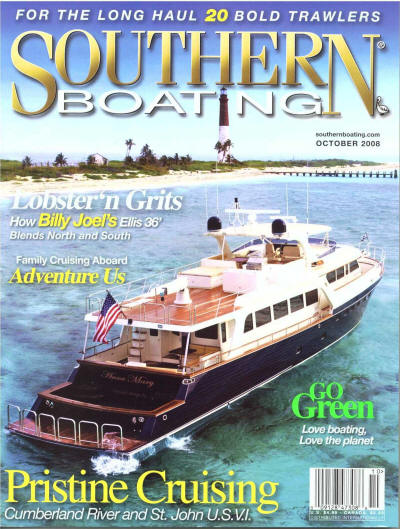 October 2008
• Southern
Boating • The
flagship of Marlow's fleet, this 86 Explorer marks the debut of an
open bridge cockpit version of the lovely 82' Command Bridge profiled
last year. This yacht is designed to take on the world's oceans with a
strong fiberglass hull incorporating Kevlar and carbon fiber for
strength and resistance to "holing", while the full stack infusion and
vacuum construction process produces a perfect strength-to-weight ratio
and improves fuel efficiency. October 2008
• Southern
Boating • The
flagship of Marlow's fleet, this 86 Explorer marks the debut of an
open bridge cockpit version of the lovely 82' Command Bridge profiled
last year. This yacht is designed to take on the world's oceans with a
strong fiberglass hull incorporating Kevlar and carbon fiber for
strength and resistance to "holing", while the full stack infusion and
vacuum construction process produces a perfect strength-to-weight ratio
and improves fuel efficiency.
Read the entire article and
see the photos at
www.southernboating.com
September 2008
• Go Boating (Australia's Monthly Boating Lifestyle Magazine) • All
Seasons Explorer
Marlow Explorer 64 by Peter Scott photos by Janey Harper •
Many manufacturers claim to produce the best cruising yacht in the
world. In fact, most of the world's high profile motor yacht
manufacturers do produce exceedingly good, seaworthy vessel, most of
which have become synonymous with world cruising. These long distance
passagemakers can be seen in the most popular or the most isolated
anchorages along the vast coastlines of every continent of the world.
What sets them apart from recreational production boats is without
doubt, their build quality, safety systems and size. Most are small
ships capable of crossing the world's oceans with ease and possessing a
level of onboard comfort and facilities which make them independent of
land based facilities. In many ways, they are the lone wolves -
resourceful, self reliant and respectful of nature. Expedition cruisers
or passagemakers, call them what you like, are the best of the best. At
the Sydney International Boat Show in August, I was introduced to one of
the finest examples of a production passagemaker I have ever seen and
had the pleasure to go aboard. The vessel was the Marlow Explorer 64, a
passagemaker that is a testament to life long dedication seldom found in
modern boat building.
June 2008
• Power & Motoryacht • by
Capt. Grant Rafter photos by Jim Raycroft • David
Marlow states his is the first company to reach the goal of "full-stack"
infusion of an entire hull of more than 80 feet; that is, infusion where
the outer skin, core, and inner skin are all laid up in one mold at the
same time. Since full-stack infusion creates such a burly product, the
86 requires no bulkheads for structural support (the two watertight ones
are there to meet Bureau Veritas safety standards).
Standing on the flying
bridge, I feel exhilarated and completely in control behind the wheel;
she is both fast and easy to drive. I feel I could take her anywhere,
and with over a 1,300-mile range at 19 mph, I'm pretty sure the new
owner will do just that. And wherever he takes her, he'll have the
knowledge that she can handle it because she's built tough. She's
definitely a boat that fits the passage-making mold.
www.powerandmotoryacht.com
»Back
to top
May 2008
• YACHTS International •
cover story by Cecile Gauert photos by
Matthieu Carlin
• The
Marlow 86E is no mere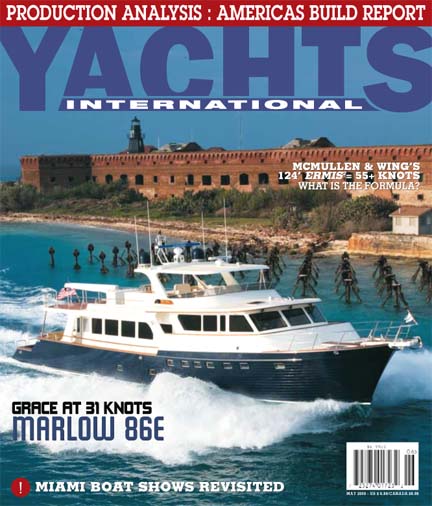 museum piece; it is meant to go places. An
experienced yachtsman who has circumnavigated the Earth so many times
that he “got dizzy,” David Marlow both understands and responds to the
needs of those who operate his yachts, be they owners or crew. “Either
you do it well, or you don’t,” says Marlow. Color-coded wiring is neatly
bundled inside conduits throughout the yacht. The pilothouse’s electric
panel pulls out completely to reveal a see-through case, allowing an
instant view of back-panel connections. A lined tunnel, large enough for
a man to crawl through, provides access to the dashboard’s electronics
displays, so there is no need to pull them out for maintenance. A hatch,
perfectly finished to match the main salon’s teak sole and insulated
with rubber so it does not damage the floor, provides a wide access to
the gel-coated fuel tank, which is located exactly in the center of the
boat. The Marlow 86E features twin Caterpillar C32s bedded on steel
mounts. This relatively modest power alone does not explain the yacht’s
performance. After leaving the dock and within seconds of a gradual and
almost imperceptible speed increase, the yacht’s GPS registers 31.1
knots. A few seconds of silence and quizzical looks invite Marlow to
declare, “I think we got the bottom right.” museum piece; it is meant to go places. An
experienced yachtsman who has circumnavigated the Earth so many times
that he “got dizzy,” David Marlow both understands and responds to the
needs of those who operate his yachts, be they owners or crew. “Either
you do it well, or you don’t,” says Marlow. Color-coded wiring is neatly
bundled inside conduits throughout the yacht. The pilothouse’s electric
panel pulls out completely to reveal a see-through case, allowing an
instant view of back-panel connections. A lined tunnel, large enough for
a man to crawl through, provides access to the dashboard’s electronics
displays, so there is no need to pull them out for maintenance. A hatch,
perfectly finished to match the main salon’s teak sole and insulated
with rubber so it does not damage the floor, provides a wide access to
the gel-coated fuel tank, which is located exactly in the center of the
boat. The Marlow 86E features twin Caterpillar C32s bedded on steel
mounts. This relatively modest power alone does not explain the yacht’s
performance. After leaving the dock and within seconds of a gradual and
almost imperceptible speed increase, the yacht’s GPS registers 31.1
knots. A few seconds of silence and quizzical looks invite Marlow to
declare, “I think we got the bottom right.”
Later, he provides
a far more detailed and technical explanation that involves a mix of
factors, including low displacement, construction techniques, trim and
propulsion angles. Another major consideration is weight. “You
don’t want to fight the wave, you want to dance with it,” Marlow says.
Marlow yachts are built in composite using proprietary Full Stack Vacuum
Infusion. The Marlow 86E is the first hull to have been treated with
Marlow’s Resin Infused Vacuum Assisted Transfer (RIVAT©), a method that
helps deliver just the right amount of resin (epoxy is this case) to the
mold, resulting in important weight-saving benefits. Employing
techniques not unlike those used in aircraft construction, the builder
has eliminated the need for thick frames to support deck soles.
Last but not least, according to Marlow, this is the first Full Stack
Infusion motoryacht to be built to full Bureau Veritas (BV)
certification. The yard’s use of epoxy resins and engineered fabrics
such as Kevlar has created a structure that “exceeds all predictions for
laminate strength yields,” Marlow says. “Unsupported panel sections on
the hull were reduced to less than one half the typical criteria for
yachts of this type providing huge margins of safety engineering, far in
excess of normal yacht standards. During the course of construction, the
yacht became referred to as the ‘Ice Class’ FRP yacht.” David Marlow has
provided much food for thought, and the tour of the new Marlow 86E has
been a real eye opener. But one image stands out with particular
clarity, and that is the yacht gleaming in the dwindling light of a Key
West sunset. The pilot, looking for just the right angle for a photo,
guides the hull through a series of arabesques. The yacht appears to be
dancing.
Complete article with photos, click here.
»Back
to top
April 2008
• Southern Boating •
"E"asy Does It by Marilyn Mower •
Marlow's latest 57E shows how evolution translates into incremental
improvements which, in turn, are making life easier all the way around
for the owner/operator and easier on the environment as well. Marlow
Yachts' use of a patent-pending resin infusion process results in twenty
two hundred pounds less resin used creating a lighter yacht using less
resin and less fuel to run her over a long ownership reducing the
yacht's carbon footprint significantly.
This Marlow
Explorer marries the saltiness of a Portuguese bridge with a true luxury
yacht interior. From flybridge to equipment room, ease of access and
maintenance is paired with yacht style and finish.
2007
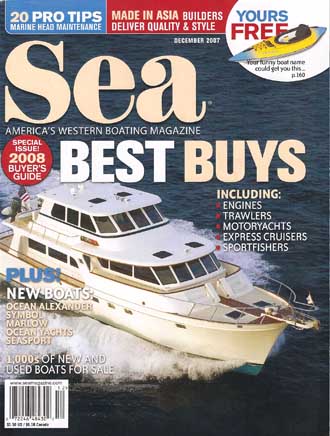 December 2007
• Sea Magazine
• Sea Trial Marlow Explorer 70E by Matt Gurnsey
• Many of
today's large, luxury yachts offer similar standard features, optional
upgrades, quality construction and seakindly hull shapes. Perhaps the
selling point in the luxury-line class comes down to whether an
affinity is felt toward the builder's creative vision and/or
operational philosophy. If so, then buyers who include on their lists of
personal values concepts such as "green building", "fair market trade"
and "environmentally friendly" may in particular be impressed by and
respond to a yacht maker that incorporates these values as part of
doing business. December 2007
• Sea Magazine
• Sea Trial Marlow Explorer 70E by Matt Gurnsey
• Many of
today's large, luxury yachts offer similar standard features, optional
upgrades, quality construction and seakindly hull shapes. Perhaps the
selling point in the luxury-line class comes down to whether an
affinity is felt toward the builder's creative vision and/or
operational philosophy. If so, then buyers who include on their lists of
personal values concepts such as "green building", "fair market trade"
and "environmentally friendly" may in particular be impressed by and
respond to a yacht maker that incorporates these values as part of
doing business.
David Marlow's
desire to build world-class yachts, and in doing so, help preserve a
pristine environment, led to the environmentally conscious development
of the Norsemen Shipyard facility in the mainland coastal city of Xiamen.
Beyond the environmental controls, the factory has earned an ISO 14001
rating, which means that it has implemented full environmental controls
over the entire manufacturing process. With environmentally friendly
practices in place, the shipyard turned its attention to training local
workers to become fine boat builders. After more than three years of
development and training, the first hull was laid up. Given the
investment of time and training and paying a workforce, this Marlow line
couldn't be anything but world-class.
Note: In this same issue of Sea Magazine is an
article entitled Made in Asia, which explores the growing
yacht-building industry of American companies in the Pacific Rim. It
specifically features information and photos of the Marlow Yachts
factory among others and is a very interesting read.
»Back
to top
November 2007
• Motor Boat & Yachting (Europe's
Premier Motor Cruising Magazine) • MBY News/New at the Show
• Marlow 57E - Marlow Yachts are something of a legend in the
US. The attention to detail is scary. The moulding in the bilges is
better than the topsides of some boats and is supplemented by
varnished teak grating to prevent your footwear having to touch anything
as ordinary as GRP. We're not kidding, the finish on this boat is
something else. The engineering is no less thorough, with access panels
to every major tank, pump or electrical relay, and the engine room looks
like an operating theatre.
November 2007 • Tenders & Toys •
Runabout: Marlow Yachts • True Beauty Is the Sum of Many Parts
• Beauty is more than skin deep with the Marlow Prowler Open
375. That's not to downplay her good looks- this vessel with pretty
lines and a saucy reverse transom turns heads wherever she goes. But her
true beauty lies in her high-tech construction, rough-water performance
and in what her builder calls her "piano-quality" finish.
The 375 is offered with inboard or
outboard power. In the diesel inboard version, the cockpit floor rises
on electro-hydraulic rams for total engine access. The outboard version
provides breathtaking performance with two or three 250-hp E-Tec
Evinrudes. The builder lists an estimated 52-mph top speed with triple
installation. No matter which power option is selected, the Prowler Open
375 is designed to provide a smooth ride in offshore conditions.
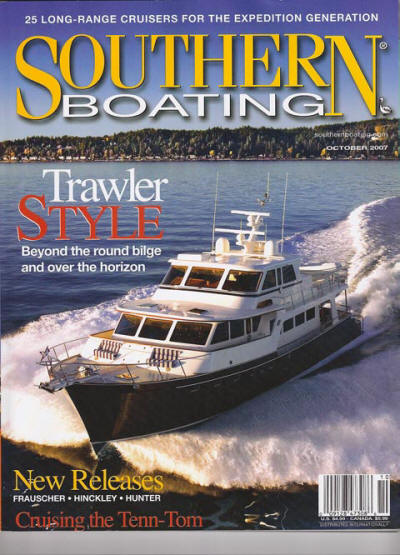 October 2007 • Southern Boating • Trawler-Type Southern Boating profiles the
latest in brawny cruising yachts • Pride of the Marlow
Explorer fleet, the 82 Cockpit Motor Yacht satisfies both the angler and
adventurer with its oceangoing hull and protected running gear,
well-designed bridge and interior spaces, and its extended cockpit.
David Marlow, chairman of Marlow Yachts, is an "early adapter" when it
comes to advanced yacht-building technology. The Marlow Explorer yachts
are laid up in China using a special Resin Infused Vacuum Assisted
Transfer (RIVAT) method to give their Kevlar-reinforced composite hulls
the optimal mix of strength and weight-savings. The 82 is certified to
ABS, ISO 9001 and Lloyds Register standards and is available with Lloyds
Certification Ocean Class Category One. October 2007 • Southern Boating • Trawler-Type Southern Boating profiles the
latest in brawny cruising yachts • Pride of the Marlow
Explorer fleet, the 82 Cockpit Motor Yacht satisfies both the angler and
adventurer with its oceangoing hull and protected running gear,
well-designed bridge and interior spaces, and its extended cockpit.
David Marlow, chairman of Marlow Yachts, is an "early adapter" when it
comes to advanced yacht-building technology. The Marlow Explorer yachts
are laid up in China using a special Resin Infused Vacuum Assisted
Transfer (RIVAT) method to give their Kevlar-reinforced composite hulls
the optimal mix of strength and weight-savings. The 82 is certified to
ABS, ISO 9001 and Lloyds Register standards and is available with Lloyds
Certification Ocean Class Category One.
June 2007 • Southern Boating • On the
Horizon-New models due to launch within the next few months
•
Marlow's latest project is also it largest offering to date, the 86
Cockpit Motor Yacht. Solid construction using Marlow's signature resin
infusion process along with an efficient hull design and 4,000 gallon
fuel capacity enable safe passages to far off ports. Storage for water
toys is located in a large transom compartment easily accessed from the
roomy cockpit. The flybridge has space to store multiple tenders and
entertain numerous guests with a wet bar, grill and plenty of seating.
June 2007 • SEA • Marlow Explorer 82
Cockpit Motor Yacht A "Big Little Ship" - by the Sea
Magazine Test team • We liked the practical elegance of the
Marlow 82. The handsome interiors and sleek exterior lines were
immediately apparent, and a closer inspection revealed many areas where
form and function come together for easy-to-operate yacht that will
catch stares of envy everywhere she goes. It's not easy to build a
sharp-looking 82-foot yacht that can satisfy all these demands- large
yachts with get-there-by -lunchtime speeds-, but Marlow stepped up to
the challenge all the same. While some might be inclined to say the
Marlow 82 looks like a slow-speed trawler, the white froth peeling off
the bow points to a speedy semi-displacement hull. Spending time aboard
the Marlow 82 will allow you to enjoy the boating lifestyle on your own
terms. Cruising in luxury, entertaining 40 of your closest friends in
comfort or setting out in search of big-water sport fish are all central
to the 82's character. To read the entire article click on the following
link.
http://www.seamagazine.com/boattests/DM_article.asp?id=4425
»Back
to top
February 2007 •
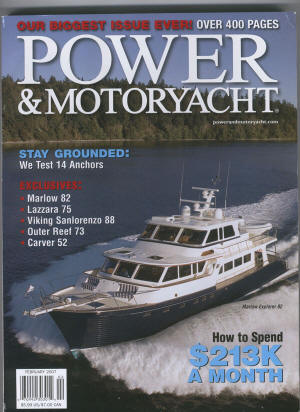 Power
& Motoryacht • Marlow Explorer 82 Cockpit MY Peak Experience -
Cover Photos by Neil Rabinowitz and exclusive article by Capt.
Bill Pike • The largest Marlow yet is an offshore beauty with
globe-trotting potential and piscatorial predilections. The 82 is in
fact designed and built to service the sort of customer who wants to
simultaneously live well and fish virtually anywhere in the world. But
there's more to fulfilling this mission than merely integrating a
complete fish-fighting arsenal; a voluminous, voyage-stretching
assortment of tanks; and a bunch of resin-infused construction methods
and materials that can stoutly contend with 18-foot seas and 50-mph
winds. Redundancy's one major consideration. Mechanical trustworthinesss
is another issue. Long-term livability's yet another vital concern. Then
finally, there's performance, pure and simple. Not only does the Marlow
Explorer 82 Cockpit Motor Yacht lend herself to lovely fish-fighting
fantasies featuring far-out, faraway places, but she's designed and
built to comfortably and reliably get you there. Power
& Motoryacht • Marlow Explorer 82 Cockpit MY Peak Experience -
Cover Photos by Neil Rabinowitz and exclusive article by Capt.
Bill Pike • The largest Marlow yet is an offshore beauty with
globe-trotting potential and piscatorial predilections. The 82 is in
fact designed and built to service the sort of customer who wants to
simultaneously live well and fish virtually anywhere in the world. But
there's more to fulfilling this mission than merely integrating a
complete fish-fighting arsenal; a voluminous, voyage-stretching
assortment of tanks; and a bunch of resin-infused construction methods
and materials that can stoutly contend with 18-foot seas and 50-mph
winds. Redundancy's one major consideration. Mechanical trustworthinesss
is another issue. Long-term livability's yet another vital concern. Then
finally, there's performance, pure and simple. Not only does the Marlow
Explorer 82 Cockpit Motor Yacht lend herself to lovely fish-fighting
fantasies featuring far-out, faraway places, but she's designed and
built to comfortably and reliably get you there.
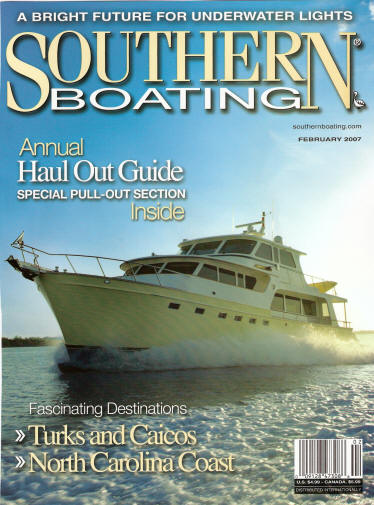 February 2007 • Southern Boating •
Marlow 72E-LR Rebel Yell - Cover Photo (above) and article
by Bill Lindsey •
From a more obvious standpoint, what makes this particular Marlow
Explorer unique is the enclosed pilothouse or Command Bridge as it is
known at Marlow. Perched up high and secure in any weather, it provides
a signature profile for the yacht, distinguishing it at a glance from
the 72C it is derived from, and making it a true all-weather choice. But
just below the waterline is a feature that makes this yacht
special. Bulbs have long been used by commercial cargo ships and cruise
ships. However, the uppermost portions of the bulbs seen on most large
ships are partially above the surface, while the bulb on the Marlow
72E-LR (Long Range) is completely submerged, albeit just barely. As with
all bulbs, the submerged design does extend the LOA, but this one also
"shapes" the water. Marlow explained that it "opens the water ahead of
the main portion of the hull allowing it to slide through with less
effort thus increasing speed and cruising range." February 2007 • Southern Boating •
Marlow 72E-LR Rebel Yell - Cover Photo (above) and article
by Bill Lindsey •
From a more obvious standpoint, what makes this particular Marlow
Explorer unique is the enclosed pilothouse or Command Bridge as it is
known at Marlow. Perched up high and secure in any weather, it provides
a signature profile for the yacht, distinguishing it at a glance from
the 72C it is derived from, and making it a true all-weather choice. But
just below the waterline is a feature that makes this yacht
special. Bulbs have long been used by commercial cargo ships and cruise
ships. However, the uppermost portions of the bulbs seen on most large
ships are partially above the surface, while the bulb on the Marlow
72E-LR (Long Range) is completely submerged, albeit just barely. As with
all bulbs, the submerged design does extend the LOA, but this one also
"shapes" the water. Marlow explained that it "opens the water ahead of
the main portion of the hull allowing it to slide through with less
effort thus increasing speed and cruising range."
As I wound up my tour I noticed a brass
plaque on the entrance to the spacious engine room and toy storage area.
It was for Lloyd's Register Quality Assurance for Category A (Ocean).
Many yacht builders would call it overbuilding, but insurers and yacht
owners call it peace of mind.
February 2007 • Boat International USA
• Marlow 70E • Sandy Lindsey •
David Marlow doesn't just build yachts; he builds heirlooms. This
philosophy is readily apparent in the new Marlow Explorer 70E Command
Bridge. The original seed for the design came from the earliest
incarnations of raised pilothouse boats that were "good for just about
anywhere in the world," according to Marlow. Their shaded aft and side
decks protected the yachtsman and his guests from hot sun in the
tropics, rain and fog in the Northeast, and the extremely unforgiving
weather of the Pacific Northwest. As Marlow began to design the series,
he added refinements to bring the robust design of these classic yachts
"out of the stone age and into the 21st century". The goal was to give
the yachts more performance, extreme long range and speed.
The 70E-CB is tailored towards the
owner-operator, who even if they have a captain, might like to take the
yacht out by themselves sometimes. First, the 70E-CB removes most of the
hassles - especially in the area of docking - that keep many a couple or
family form running their own boat in this size range. Low freeboard and
windage means the yacht is less susceptible to wind and currents and
therefore, easier to maneuver at the dock. The protected, walk-around
bulwarks are designed to facilitate tying up with just the owner at the
helm and his or her spouse with the dock lines in hand. Large hardware
makes securing lines of all sizes simple. The cleat placement is
logically thought out, so even an inexperienced guest can make fast the
yacht, if needed.
David Marlow explains his commitment to
building quality yachts that stand out form the crowd. "One customer
asked me to put the Marlow name on the side of his boat on a custom
stainless steel plate. I refused. I want someone to know a yacht is a
Marlow just by looking at it."
»Back
to top
February 2007
• Sea • Just Launched •
Marlow Explorer 72E Command Bridge • Florida-based Marlow Yachts,
will debut its newest model, the Explorer 72E command Bridge, at the
February 2007 Miami International Boat Show. With the distinctive style
of the Explorer line, the Command Bridge features the quality,
performance and innovation that Marlow is known for.
January 2007 • Southern Boating •
Marlow 78E • The new Marlow 78E allows you to travel in total
luxury and comfort wherever your journeys might take you. Boasting an
impressive range of 967 nautical miles at a more than ample cruising
speed of 17 knots, there are no limits except your own imagination.
January 2007 • Power & Motoryacht •
MarlowProwler
375 •
Cat-like performance, highly advanced
technology, and the finest attention to detail have created Prowler,
another benchmark of excellence from Marlow that is difficult to
emulate. ...Prowler is born as an immensely strong, high-speed yacht
whose looks will take your breath away.
»Back
to top
2006
November 2006 • Soundings •
Made in China by Jim Flannery/Senior Writer • This extensive
and informative article explores the boating scene in China both as a
luxury market and as a boat-building center. With the explosive growth
of the luxury market (Goldman Sachs says China is now the world's third
largest consumer of luxury goods), one can find representatives of most
of the high end retailers including Bentley, Ferrari, Gucci, Cartier and
Louis Vuitton. Whether boat sales will become active is the big
question. Building boats in China, however, is another matter
altogether. An article embedded in this article is entitled : David
Marlow: Setting the bar high for boatbuilding in China. David Marlow set
out to build the best boat he could in the greenest and most socially
responsibly way he could to show his host - the People's Republic of
China - that he not just another carpetbagger come to siphon off quick
profits from it's burgeoning economy. He says he is making an investment
in China's future. In 2003 Marlow opened Norsemen Shipbuilding Ltd. on
25 acres near coastal Xiamen. The facility is a model of environmental
and social responsibility for China and the rest of the world. Marlow
Yachts and Norsemen Shipbuilding Ltd. won the 2006 World Superyacht
Environmental Award for their environmental policies and
practices.
(See the article below on the 2006
World Superyacht Awards)
October 2006 • Southern Boating •
Marlow 70E • Making its debt at the Ft. Lauderdale
International Boat Show (note: Oct. 26-30, 2006), the new Marlow
Explorer 70E Command Bridge is an offshore cruising vessel certified to
CE certification by Lloyd's Register Quality Assurance for Category A
(Ocean). Like all Marlows, the 70E features an
impeccable level of fit and finish throughout the boat with luxurious
touches including high gloss interiors. The range can be extended to
1,700 nautical miles by cruising at a stately 9 knots.
September/October 2006 • Asia-Pacific
Boating • Marlow thinks big • Marlow has unveiled its
largest model to date, the Marlow Explorer 82 Cockpit Motor Yacht.
Targeted at the adventurous fisherman, the vessel boasts an extended
cockpit and a large winch that is operated from the cockpit. She is also
fitted with a complete tackle center and an Eskimo ice maker that will
make shaved ice continuously from salt or fresh water. Marlow Yachts
construction techniques have been certified by ABS (American Bureau of
Shipping), Lloyds Register, ISO 9001, and offered with
CE certification by Lloyd's Register Quality Assurance for Category A
(Ocean). This
classification is a status enjoyed by less than a handful of pleasure
powerboat manufacturers
September 2006 • Boat International
USA • Marlow Yacht's Largest Ever • Marlow has
launched an 82ft explorer-style fishing vessel. With a long-range
capability advanced enough to allow the yacht to cruise from mainland
Central America to the Galapagos, troll for five days and return without
refueling, the new Marlow Explorer 82 Cockpit motor yacht combines the
Marlow Explorer series stle wit an extended cockpit and bridge.
September 2006 • Power & Motoryacht •
Just launched - Marlow 82 Cockpit Yacht by Jeffrey Moser •
The concept behind a yachtfisherman is simple: Build a boat that may not
outrun the 40-plus-knot convertibles to the fishing grounds but has
significantly more range and an interior that offers the comfort and
equipment essential for long-range passagemaking. And that's exactly
what you get in Marlow Yachts' latest offering, the 82 Cockpit Yacht, as
Hull # 1 has been rigged with both fishing and comfort in mind.
September 2006 • SEA • Out to
Launch - Marlow 82 Cockpit Motor Yacht • Marlow Yachts has
announced the debut of its largest model to date - The 82 Cockpit Motor
Yacht. Form meets function in this luxurious vessel, with a cockpit and
flybridge designed for the most adventurous angler. The extended cockpit
is ready for a big catch with double tuna doors, auxiliary controls, a
complete tackle center and a lighted bait tank with a clear front for
viewing. A large winch can also be operated from the cockpit. The 82's
long-range capability and 3,000-gallon fuel capacity encourage extended
cruising to Alaska or other far-away ports.
August/September 2006 • Tenders & Toys
Show Boats International • Marlow Open Season • Few
vessels share the rare pedigree and retro looks of the Marlow Prowler
series of powerboats, which derive from the early days of offshore
racing. Yachtbuilder David Marlow resurrected and modernized the
design in 2003 with the Marlow Prowler 375 Classic. At the 2006 Miami
International Boat Show, aficionados feasted their eyes on the latest
Prowler, which - though christened the Open 375 - also sports a very
comfortable cuddy tucked away beneath the foredeck.
»Back
to top
August 2006 • Yachting •
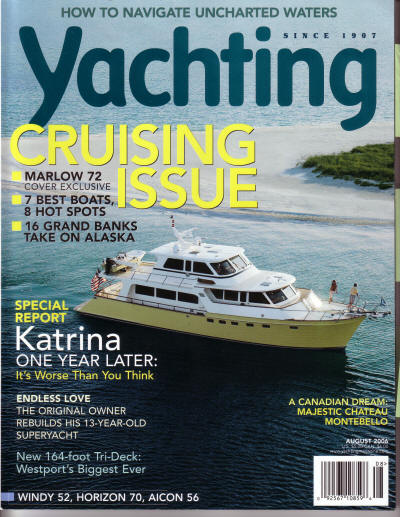 Marlow's Masterpiece, 72E-LR (see cover) by Jay Coyle and
Photos by Gary John Norman • Rebel Yell is the first 72E-LR,
the "E" signifying her Euro reverse transom and "LR" her long range. Her
3,450-gallon fuel capacity expands the owner's opportunities, making
them almost endless. ...at 6.4 knots we were burning just 1.3 gallons
per hour with the C18 Caterpillar engines. Top cruising speed was a bit
more than 22 knots. Her design is based on Marlow's successful 72C
(conventional transom), and while she shares a family resemblance, her
enclosed bridge distinguishes her from the other models. This is a major
advantage in terms of interior volume, as it and the lounge allow the
main deck to be devoted to her saloon aft and a casual galley/dining are
(forward). Rebel Yell meets European CE (Ocean category) standards
and Marlow intends to apply the CE standard throughout the Explorer
Series line. Marlow is ready to share, so if you have the perfect yacht
in mind, the 72E-LR is now in production. Marlow's Masterpiece, 72E-LR (see cover) by Jay Coyle and
Photos by Gary John Norman • Rebel Yell is the first 72E-LR,
the "E" signifying her Euro reverse transom and "LR" her long range. Her
3,450-gallon fuel capacity expands the owner's opportunities, making
them almost endless. ...at 6.4 knots we were burning just 1.3 gallons
per hour with the C18 Caterpillar engines. Top cruising speed was a bit
more than 22 knots. Her design is based on Marlow's successful 72C
(conventional transom), and while she shares a family resemblance, her
enclosed bridge distinguishes her from the other models. This is a major
advantage in terms of interior volume, as it and the lounge allow the
main deck to be devoted to her saloon aft and a casual galley/dining are
(forward). Rebel Yell meets European CE (Ocean category) standards
and Marlow intends to apply the CE standard throughout the Explorer
Series line. Marlow is ready to share, so if you have the perfect yacht
in mind, the 72E-LR is now in production.
July/August 2006 • Boat
International USA • Boat International Group presents World
Superyacht Awards Venice 2006 •
 At
the Foundation Cini, among Venice's most elegant of backdrops, the first
annual World Superyacht Awards were presented during a gala evening on
April 28th at a Palladian palace on the island of San Giorgio Maggiore,
just across the water from Saint Mark's Square. 16 awards, chosen by an
esteemed panel of judges, which included the owners of six significant
superyachts, were presented to the winners by the editors of the Boat
International Group and special guests. At
the Foundation Cini, among Venice's most elegant of backdrops, the first
annual World Superyacht Awards were presented during a gala evening on
April 28th at a Palladian palace on the island of San Giorgio Maggiore,
just across the water from Saint Mark's Square. 16 awards, chosen by an
esteemed panel of judges, which included the owners of six significant
superyachts, were presented to the winners by the editors of the Boat
International Group and special guests.
Marlow Yachts Wins
Environmental Award
 Several noteworthy groups and technologies were nominated for
this award, however there are few organizations within the maritime
industry who have demonstrated the degree of dedication to the
environment as Marlow Yachts. Continuously innovating ways to reduce the
impact of yachting on the world's oceans and resources, Marlow is a
living example of comprehensive environmentalism - both their pristine
Snead Island, Florida facility and the 25 acre waterfront Norsemen
Shipyard in Chi Hu Valley, China, are complex service work sites, which
, contrary to the norm, maintain stringent enviornmentally-friendly
standards, the latter with the ability to haul yachts up to 165 feet
from a seawater basin with a 984 foot breakwater. Among Marlow's
policies are extensive safeguards to prevent pollutant release, while
air ventilation is designed optimally in all operations, and a closed
molding system for laminating eliminates styrene emissions. Aboard every
yacht is complex, patented system which results in cleaner cooling
systems with more efficient operations. Marlow is also preparing for ISO
14001 category certification, a stringent standard which requires the
manufacturer to implement full environmental controls on every segment
of the manufacturing process from purchasing through receipt and final
use of the products involved.
Several noteworthy groups and technologies were nominated for
this award, however there are few organizations within the maritime
industry who have demonstrated the degree of dedication to the
environment as Marlow Yachts. Continuously innovating ways to reduce the
impact of yachting on the world's oceans and resources, Marlow is a
living example of comprehensive environmentalism - both their pristine
Snead Island, Florida facility and the 25 acre waterfront Norsemen
Shipyard in Chi Hu Valley, China, are complex service work sites, which
, contrary to the norm, maintain stringent enviornmentally-friendly
standards, the latter with the ability to haul yachts up to 165 feet
from a seawater basin with a 984 foot breakwater. Among Marlow's
policies are extensive safeguards to prevent pollutant release, while
air ventilation is designed optimally in all operations, and a closed
molding system for laminating eliminates styrene emissions. Aboard every
yacht is complex, patented system which results in cleaner cooling
systems with more efficient operations. Marlow is also preparing for ISO
14001 category certification, a stringent standard which requires the
manufacturer to implement full environmental controls on every segment
of the manufacturing process from purchasing through receipt and final
use of the products involved.
»Back
to top
June 2006 • Power & Motoryacht •
Smooth Criminal by Jeffrey Moser • The Prowler Open
375 is a refined gentleman's runabout with a scandalous past. As I took
in her graceful sheerline, deep blue topsides, and tumblehome, one thing
became as clear to me as the spring-fed waters at Marlow Marine: David
Marlow marches to a drum that others do not hear, which is why the
37-footer is unlike any other outboard-equipped center console out
there. It's not just the 375's look, it's in the details that put her in
a league of her own.
May 2006 •
SEA • Marlow Explorer 57E Command Bridge by Walt Jennings •
She was secured to a dock in small protected harbor, and I found her
to be awe-inspiring as she sat there, awaiting a command - the Marlow
Explorer 57E Command Bridge. I'm kind of a mechanical "trekkie" and when
I entered the engine room I wasn't just impressed, I was extremely
impressed, because everywhere I looked I saw things I liked - items that
are options on most boats are standard on Marlow Explorer. I could write
a separate article about what I found in 57's engine room. ...if
you are looking for a functional, livable, homey feeling in a
state-of-the-art luxury yacht, built to standards most people have never
seen, you owe it to yourself to look at these - not just boats, but
works of art that David Marlow is building.
April 2006 • International
Yachtsman • Marlow Explorer 65C by Sandy Lindsey • Five
years after debuting the venerable 65C at the 2001 Miami International
Boat Show, Marlow Explorer has enhanced it with all the advancements
gained in the intervening years, expanding the Explorer series to 11
models ranging from 53 feet to 78 feet. Nowhere is Marlow's credo, "Each
one is better than the one before," more apparent than in this latest
offering. The new 65C has gone on a diet without compromising
performance or integrity. The hull is about 4500 pounds lighter due to
considerable improvements in the fiber/resin ratio during lamination
since Hull #1. The new 65C has an increased range via a larger fuel
capacity...A unique fuel delivery system on the new 65C results in a
single valve to direct all fuel distribution - a highly efficient
update. Like the original 65C and the Marlow Explorer yachts that have
come after and are currently cruising the globe, the updated 65C
combines the best in materials and workmanship, along with extensive
quality control when it comes to design, materials and installation.
April 2006 • Southern Boating •
Weekend Adventures-Biscayne Bay & Ocean Reef Club by Bill
Lindsey • Some say this it is not the destination but the journey
that is important while others claim it is the companions you travel
with that make the trip memorable. We have a third option: The best of
all worlds is when the destination is great, the journey an adventure,
and the company a blast to be around. The day after the Miami boat show,
I hitched a ride through Biscayne Bay with David Marlow aboard a new
Marlow Explorer 78 motoryacht. I convinced him to spend the night at
Ocean Reef Club located on Key Largo, a private, members-only facility,
with the promise of a dinner at the Club. While the boat was at Ocean
Reef a steady stream of admirers came by to look at it and ask
questions. More that a few of these were surprised to learn that the
crewmember dressed casually in shorts and a T-shirt who seemed to know
so much about the boat was actually the builder.
»Back
to top
April 2006 • Southern Boating •
 Since this is the the magazine's 20th Annual Swimsuit Issue, there is,
of course, a lovely model in a stylish bathing suit on the cover. If you
can move your focus out a little from her loveliness and look at the big
picture, you will see that she is perched on the bow of Marlow Prowler
375 Open. There is also a wonderful two page photo of this special yacht
inside. While we feel this yacht needs nothing to enhance it's classic
styling, we will admit that these bathing beauties add a little extra
pizzazz! Since this is the the magazine's 20th Annual Swimsuit Issue, there is,
of course, a lovely model in a stylish bathing suit on the cover. If you
can move your focus out a little from her loveliness and look at the big
picture, you will see that she is perched on the bow of Marlow Prowler
375 Open. There is also a wonderful two page photo of this special yacht
inside. While we feel this yacht needs nothing to enhance it's classic
styling, we will admit that these bathing beauties add a little extra
pizzazz!
March 2006 •
Boat USA International • Marlow Yachts has been nominated for the
Environmental Award, a category of awards in the World Superyacht
Awards. The winners will be announced at a gala black-tie affair in
Venice, Italy at the end of April. Marlow Yachts was nominated for its
efforts in keeping environmental responsibility at the forefront of
their boat building operations. Its Xiamen, China facility is one of the
most modern boat production factories in Asia, and the first and only to
participate in a 'green' environment policy. Located along a protected
harbor, this custom boat building facility has been constructed to
ensure optimum air ventilation in all operations, with dedicated
fiberglass rooms and a closed system that guarantees virtually perfect
resin-to-glass ratios, and eliminates styrene emissions. Ozone-depleting
fire retardant chemicals have been discontinued throughout the builds
and facility, replaced by the adoption of CE standards for yachts in this area and others.
March 2006 • Showboats • underway
by Jill Bobrow, Editor • Optimism Afloat - Our feature
"Orient Express, Boat Building in China" is another can-do tale. George
Sass, Jr. traveled to Asia and learned how building in Taiwan-despite
political differences-has spawned a whole new industry in mainland
China. Who would have predicted a country that underwent a communist
revolution a mere generation ago would today be building megayachts?
David Marlow, for one. Almost 13 years ago he scoured Asia looking for
new places to build. He started building in Taiwan at the start of the
new millennium, but as Taiwan became more and more a first world nation
he sought new frontiers where he could produce the quality his customers
wanted at more economical prices. Phasing out of Taiwan, he has
established -through sheer perseverance- an environmentally friendly,
high-tech yacht yard with top-notch engineers, carpenters and builders.
Witness the craftsmanship and quality of Marlow Yachts and the waiting
line to get one and you know that someone's optimism paid off!
March 2006 • Showboats • Orient
Express - by George Sass, Jr.• China is on the fast track to
becoming the next Asian boat-building center. Today, Marlow, like
several of the aforementioned yards, has settled in mainland China in an
attempt to control costs and increase quality. "China emerged the clean
winner for us by virtue of the natural assets of people, suitable land,
raw materials and support," says Marlow. Other yards have followed. As
the Taiwanese economy becomes more developed the trend for boat builders
to move a portion or all of their operations to China should continue.
»Back
to top
February 2006 • Boat Digest • Hot
New Designs -Prowler 375 Open • Yikes! If this mew Prowler
doesn't accelerate your pulse, see a cardiologist. She successfully
combines the spoon bow of a traditional New England workboat with a
thoroughly contemporary foredeck and hardtop. Weekends aboard-no problem
in this cabin.
February 2006 • Southern Boating •
This Month's Designer's Choice - Marlow Yachts' Open Prowler 375 •
The all new Open Prowler 375 will debut at this month's Miami
International Boat Show. It shares a hull with the Prowler 375
introduced at last years show, but all the other features are unique to
this boat. It was designed to be powered by twin inboard engines or by
two or three Evinrude E-TEC 250-horse powered outboard engines. When
equipped with a trio of E-TEC engines, the Open Prowler will rocket
along at 52 mph. Cruising at 48 mph, it has an impressive range of 450
nautical miles. This is a boat that has long legs and the ability to
cross long distances in a hurry.
February 2006 • Marine Business
Journal • Marlow Yachts Limited, Inc. Expands to Australia & New Zealand
• Marlow Yachts Limited has selected Explorer Marine Australia to be
the exclusive dealership for its line of yachts in Australia and New
Zealand. Explorer Marine is located in Sydney, Australia. The dealer has
already found a buyer for the first Marlow Explorer 70E it ordered, even
before it had begun formal marketing of the line in the region.
February 2006 • Marine Business
Journal • Marlow Expands Company • Marlow Yachts Limited, Inc. has
appointed Eric Zobel, located in Barcelona, Spain, as the representative
of Marlow Explorer Yachts in Spain. Zobel is the first of several
international placements that will be announced by the company in the
coming months as they continue their expansion into international
markets.
Marlow as also announced plans to
expand its manufacturing center, Norsemen Shipyard, located in Xiamen,
China. Marlow has purchased 50 acres of adjoining oceanfront property to
build a visitor's center and provide for future expansion.
»Back
to top
2005
December 2005 •Motorboating •
Cat Walk The Marlow Prowler is special on the outside and the
inside • Jay Coyle tested this yacht and proclaims Grace under
power: The Prowler's ride is as pleasant as her styling. She lifted to
plane easily and reached a top speed of 34.3 knots in 20 seconds. This
is truly a unique yacht design. A boat that is the vivid and passionate
dream of an individual, not a clever product shaped by a focus group, is
rare. When I spoke to David Marlow about his new creation, the Prowler,
I had the sense that he really doesn't care how many he sells. For him
this project was a labor of love that brought him full circle in a
lifetime on the water.
November 2005
• Sea • Marlow Prowler 375 Gorgeous vintage styling veils
this cat's pounce • Matt Gurnsey does the Sea trial on this yacht
and writes: We're running along at nearly 30 knots, a light wind
barely rippling the surface of Lake Washington. The sun glints off an
aluminum fishing vessel heading toward us. With a turn of the richly
varnished wheel, we head toward the wake of the 60-odd foot vessel. The
boat hits the wake: Bump. Bump. Bump. The wall of spray coming off the
side of the hull increases as we hit each rise. And that's it. Not a
rattle, squeak or groan from anywhere on the boat. For a vessel that
traces her heritage back to the rough-and-tumble rumrunners of the past,
the new Marlow prowler 375 is surprisingly civilized.
»Back
to top
September
2005 • Boat Digest • On the Prowl Marlow's Prowler 375
carves her own niche in the down east market • with a photo on the
cover of this issue, George Sass, Jr. sea trialed this boat and writes:
The 375 reflects Marlow's own background and sensibilities. He and
his wife Barbara spend the summers between Snead Island, Florida and the
coast of Maine, and the Prowler seems to take styling queues from each
of these strong boating fountain heads. First of all, he's toned down
the lobster boat inspired look of a flared bow and straight stem.
Instead, he's developed a profile that incorporates some retro qualities
mixed in with modern, crisp lines. The result is a sweet little package
that pulled glances from curious boaters as we meandered down Key
Biscayne for our sea trail.
August 2005 • Northwest Yachting •
The Marlow Prowler 375 is a high-tech, high-quality yacht with
the timeless lines of a commuter or picnic boat. With its sleek profile
and its flag-blue and oyster white coatings, the look is stunning. Its
two-foot draft and 30 knot speed give you the ability to run to the San
Juans or up to the Delta quickly and comfortably. The cockpit is
innovative, with plenty of seating hiding a fold-away cockpit dining
table. The salon is large and open, with a queen berth on centerline
forward. A fresh approach from a first-rate builder, the Prowler is
perfect for a couple cruising for a long weekend. Cat like performance,
highly advanced technology and the finest attention to detail have
created another benchmark for excellence from Marlow Yachts.
July 2005 • Yachting Magazine •
Explorer Extraordinaire Chris Caswell sea trialed this yacht and
wrote: You can pack your tux when you take the Marlow 57E Command
Bridge to the ends of the earth. The bottom line is that the Marlow
Explorer 57 Command Bridge is one of those highly desirable yachts that
is built well, performs well and looks good. It's a tough combination to
beat...
June 2005 • Southern Boating •
At first glance, the Prowler has the look of a well-tended classic,
but beneath the surface of gleaming, exotic wood lies a high-tech
vessel. It is intended to fill the needs of those seeking a casual,
comfortable day or weekend cruiser. The first owners have been owners of
Marlow Explorer motoryachts, seeking a "small" boat for impromptu
outings.
»Back
to top
J une 2005 • Power & Motoryacht Magazine
• This edition featured the
Prowler by Marlow Yachts on the cover and in an exclusive story by
Capt. Bill Pike, You Can Go Home Again
• PMY tested
the Prowler 375 Panther series yacht in Tampa Bay in two to four
foot seas and then proceeded to the west coast fishing village of
Cortez for a glimpse into the past - where the idea for the Prowler
took shape.Close-quarters handling (away from the dock) was easy; the
boat's low profile cut windage and there was enough bite in the
props to pivot the boat efficaciously. Handling offshore was fun...
Top speed in two-to four-foot seas was 40.6 mph...Turning was
sporty, and Panther tracked like she was sent for. une 2005 • Power & Motoryacht Magazine
• This edition featured the
Prowler by Marlow Yachts on the cover and in an exclusive story by
Capt. Bill Pike, You Can Go Home Again
• PMY tested
the Prowler 375 Panther series yacht in Tampa Bay in two to four
foot seas and then proceeded to the west coast fishing village of
Cortez for a glimpse into the past - where the idea for the Prowler
took shape.Close-quarters handling (away from the dock) was easy; the
boat's low profile cut windage and there was enough bite in the
props to pivot the boat efficaciously. Handling offshore was fun...
Top speed in two-to four-foot seas was 40.6 mph...Turning was
sporty, and Panther tracked like she was sent for.
May-June 2005
• Power Cruising • On the Horizon- Marlow Explorer 53C - The 53C
was created to address customer requests for a smaller version of the
company's well-respected Explorer Yachts. Capable of extended ocean
voyages and easily managed by a couple, the 53C embodies all the design
characteristics of the company's larger vessels, including a hull shaped
for comfortable operation in challenging offshore conditions.
May 2005 • Yachts International •
Making Waves-New Launches & Industry • Marlow Yachts 61C - Among
the Marlow Explorer 61C's attributes is expansive interior volume for a
yacht this size. The absence of bulkheads, thanks to her sophisticated
construction materials and techniques, creates a remarkable sense of
space without sacrificing storage.
May 2005 • Yachts International •
Making Waves-New Builds & Events • Marlow Yachts hosted a debut
party prior to this year's Miami International Boat Show in celebration
of their eighth 78' Explorer; their first 57E Skylounge; and the new
Prowler day cruiser. The Miami Beach Rod and Reel Club catered to 100
Marlow owners under the stars, amid a Great Gatsby theme with sparkling
candles, soothing music and beautiful yachts. One of the party's major
highlights was Dameon, a young black leopard that accompanied the
Prowler series. David Marlow, who is known for his environmental
concerns in all his business endeavors, said: "We hope that the beauty
and elegance of these exotic wild cats would remind us to do our part on
a daily basis to save the world for future generations." Certainly the
the yachts were the ultimate highlight.
»Back
to top
May 2005 • Sea Magazine • Dream Boats • Marlow Explorer 78 -
Efficiency and Luxury go hand in hand- Marlows are spacious and are
known for the high quality of their equipment and materials. The company
even developed its own high-end tender, called the SPRITE, which can
seat up to six and features trim details coordinated well enough to the
mothership that it would put Armani to shame.
March 2005 • Yachting •
Driven to Perfection The new Marlow Explorer 78 is the result of one
man's passionate commitment to the absolute best in cruising design •
George Sass Jr. "It was in this office several years ago that I first
learned of the Marlow Explorer 78. Eighteen months later, having had the
chance to see the finished product, I think I can attest that this piece
of complicated carpentry "worked". Moreover, I'll go on record as saying
that the entire 78 is one of the best examples of seni-custom
boatbuilding that I've ever seen."
March 2005 • Southern Boating •
New boat Review Marlow Explorer 61C • "If the Marlow Explorer 61C had
to be summed up in one word, it most likely would be "capable". In
addition to an exterior design that looks ready to to take on any ocean
on the planet, everything on board the 61C makes sense. All aspects are
well thought out, with meticulous attention to detail."
March 2005 •
MotorBoating • Chris Caswell reviews the Marlow Explorer 53C •
"After following David Marlow up and down throughout his new 53-footer,
I was still trying to find two things. One was a part or fitting that he
didn't know intimately and hadn't chosen personally. The other was some
flaw in this yacht. I failed to find either. The Marlow 53C is the new
"baby" in the Marlow line, which previously had started at 57 feet. A
smaller yacht from this builder surprised many people in the industry,
but its lineage is pure and there's nothing small about this 53, which
can easily by handled by a couple and can just as easily cross oceans."
»Back
to top
February 2005 •
International Yachtsman • Sandy Lindsey reviews the Marlow Explorer
78 • The principals at Marlow Explorer Yachts know the best way to
dramatically show off their product, especially during sea trials.
During the maiden voyage last fall of one of the builder's new 78E
yachts on the Yellow Sea, the boat and crew had to battle violent seas
and headwinds. Twin Caterpillar 700-HP diesel engines kept the yacht on
track through a 5-knot current. Green water poured over the decks and
the swells were deep. Yet the crew and passengers were safe and dry,
enjoying a roomy interior that skimps on nothing when it comes to
comfort and luxury.
February 2005 • Boat USA
International • Matthew Esposito
reviews the Marlow Explorer 78 Flushdeck •
“The Marlow Explorer, the whole vessel, is a tangible encyclopedia
of innovative ideas in boat building. And though slightly more
expensive than your average Britannica set, I would definitely
recommend picking one up. People say perfection is unattainable, if
so, at least the people at Marlow are trying.”
February 2005 • Boat USA
International • Around the World • Marlow joins the picnic
- Marlow has a new lobster boat-cum-day cruiser: the Prowler Yachts
express cruiser. The first in the series is the 37' Prowler Panther
series. The Marlow company is committed to bringing not only the highest
quality product to market but doing so in an environmentally responsible
way and the Marlow line of Explorer Yachts has also recently received
Lloyd's certification, an impressive feat. The Marlow Explorer now
features this Lloyd's Offshore Category One classification in addition
to ABS and ISO 9001 certification, a status enjoyed by less than a
handful of pleasure powerboat manufacturer`s worldwide and the first for
a Chinese manufactured product.
January 2005 • Yachts International
• Making Waves-New launches, designs and industry-Prowler 375
Marlow Yachts-David Marlow will introduce his new Prowler Yacht
series of express cruisers at the 2005 Miami Boat Show. The first in the
Prowler series- built at Norsemen Shipyard in China is the 375, a 38'
pocket motoryacht that utilizes infusion and pressure vacuum bagging of
carbon fiber, Kevlar and core cell foam in the hull. The 375 is a
strong, high-speed yacht.
January 2005 • Yachts International
• Making Waves-New launches, designs and industry-Sprite
Tender 15' Marlow Yachts-Marlow Yachts developed a proprietary
tender for owners who want to increase their arsenal of water toys.
Sprite tenders deliver great handling with a wide body to ensure a
comfortable and a safe ride. Sprites include the same molded non-skid
decks, colors, trim details and inlaid ebony joinery as their mother
ships.
»Back
to top
2004
July 2004 •
Power & Motoryacht • Exclusive review of the Marlow Explorer 78E •
Sea Wolf • Capt. Bill Pike writes "The
simple truth of the matter is that the heights of the graybeards Marlow
Explorer president David Marlow and I tangled with on that tempestuous
February day, a dozen miles east of the Miami sea buoy, were ten feet on
average and occasionally 12 feet. Moreover, the wind was blowing between
25 and 30 mph, and there wasn't another vessel in sight, except for a
containership...I ultimately came to enjoy such confidence in the boat's
unswerving forward motion (in a down-sea heading) that I could
occasionally turn my head from the Stidd I was sitting in on the flying
bridge and admire the big, blue rollers sweeping behind us...While the
boat's classical lines, state-of-the-art engineering, and high-tech
construction were great, her offshore capabilities had darn near blown
my socks off."
June 2004 •
Boat USA International • Review of the Marlow Explorer 70E &
David Marlow - Profile of the Man behind the Marlow Explorer Series
• Jill Bobrow writes "The 70E is just one of the series of
models ranging from 53ft to 78ft that Marlow builds. Each and every
model is a gem unto itself. With each new endeavor, it is obvious that
David Marlow pushes the envelope a little further. Is it worth it to
wait in line at the boat shows? Bring a book with you, or better yet,
your checkbook!"
May 2004 • Southern Boating •
Review of the Marlow Explorer 61E-Globe-Roaming Range, World Class
attention to Detail "Marlow's innovative construction
methods and unique Velocijet keels deliver seakindly handling, even in
heavy weather...the Marlow 61E is yet another example of why this
builder has garnered such a loyal following in such a short time. If it
makes sense and makes for a better boat, chances are you'll find it on a
Marlow."
May 2004 • SEA Magazine • Sea
Trial of the Marlow Explorer 61E • Tom Thompson writes "This
unique go-anywhere yacht is the result of one man's dream. It is
difficult to separate David Marlow from the boats that he builds. Each
is interrelated. Marlow loves his work, and there is much of him in his
latest creation: the Marlow Explorer 61."
»Back
to top
2003
December 2003 • Yachting •
Marlow Magic - a review of Marlow Explorer 57C • George Sass, Jr.
writes "It is abundantly clear that this yacht is not intended to
collect barnacles while doing time as a waterside condo. This is a
cruising boat. Details such as conveniently placed grab rails for use
while under way, drawers with positive latches to keep them closed at
sea, and proper night lighting all make a difference when cruising. The
attention to the systems follows the same thinking. A small sampling of
the extensive standard-equipment list includes a split freshwater system
with a tap for drinking water, drawn from a polished stainless-steel
tank and one for domestic use, dual 50-gallon water heaters, two
Glendinning Cablemasters, a washer and dryer and reverse-cycle air
conditioning.
This article started out as a four-page feature, then grew to five pages
and is now six. Still, a number of great things about the Marlow
Explorer 57 remain unmentioned. She is a yacht that deserves the time of
prospective buyers. Better yet, they should spend some time with David
Marlow and his staff, learning all they can about the other few hundred
stories behind the magic."
July 2003 • Power & Motoryacht •
Cutting Edge - The Marlow Explorer 72 is simply a superbly
crafted passagemaker • Capt. Bill Pike writes "After I took the wheel, the Explorer
ran with unruffled ease in the open Atlantic, as if the four- to
six-foot combers that prevailed there simply didn't exist. Visibility
was great, all the way around. The ride was smooth and dry and the
steering responsive, thanks both to Hynautic hydraulics, a gutsy
power-assist system that boasts two big engine-drive pumps (one on each
main), and a special effort-multiplying device that accelerates rudder
response when the steering wheel is rapidly turned.
Going down-sea was the real highlight of the sea trial, however - yaw
( the side - to - side slewing so typical of most vessels with broad,
flat transoms like the Explorer's) was virtually absent. Marlow credited
this phenomenon to a patented, hydrodynamically shaped pair of molded-in
skegs that run the length of the vessel's propeller pockets- Velocijet
Strut Keels, he calls them. Not only do they consolidate
turbulence-inducing aspects of running gear into fish-slippery
protective housings (with big bearing lubricated by engine waste water),
they also augment directional stability, particularly in following seas.
There were simply way too many
noteworthy engineering and other details to mention in a single boat
test article." July 2003
• Boating Industry News • Marlow chooses "green" factory
in China •
XIAMEN, China – Norsemen Shipbuilding,
Ltd. will produce Marlow Explorer Yachts' new series of Raised Pilothouse
yachts in its "green" factory located north of Hong Kong, Marlow
announced in a recent statement.
Norsemen is reportedly the most modern boat production factory in Asia and
the first to participate in an environmentally responsible policy. The
factory is situated along a protected harbor of the China Sea, but instead
of building a seawall around the basin where boats are launched, massive
boulders have been placed to create a long breakwater into the ocean. It
provides a habitat for fish and lobster as well as preventing erosion,
according to the company.
Norsemen also prohibits the spilling or pouring of chemicals on the ground
or released into the air, according to Marlow. A fiberglass cutting room
building uses technology to eliminate most airborne pollutants. A
proprietary technique for laminating, called RIVAT, is a closed system
that insures virtually perfect resin to glass ratios and eliminates
emissions of styrene into the atmosphere, Marlow reported.
Many of the workers were born in the surrounding native fishing villages
where boat building has been a way of life for more than 300 years.
Workers can chose to live on site in a modern apartment complex, offering
recreational facilities, full laundry facilities and a complete kitchen,
Marlow reported. The 200-apartment complex is located 150 meters upwind of
all molding or FRP operations to assure safety."
»Back
to top
2002
November
2002 • Yachting magazine • 70 Marlow Explorer - A beautifully
crafted yacht from a dedicated, knowledgeable builder • Jay Coyle
writes "There are a lot of decent boats built in Taiwan these days
but the 70 Marlow Explorer is different. She has the very special feel
of a boat built without compromise. David Marlow spared no expense in
creating the 70, yet not a cent was invested in her thoughtlessly. Her
outfitting and finish are exceptional, yet her price is a bargain in her
class.
If the
the 70 were just an average boat, her $1,500,000 base price would be a
good deal. She is much more. She is proof that it's not simply money
that makes a great boat."
June 2002
• Motor-Boating magazine • High Seas Explorer - a sea trial
of the Marlow Explorer 65C • Capt. Stuart Reininger writes "I
was able to better understand the joy of these 65 buyers-most of whom are
experienced boaters-during our test runs through the slop off Miami. This was
not your basic luxury liner reluctantly working its way through unpleasant seas.
Marlow claims that the Explorer was bred for conditions that make other yachts
scoot towards the nearest port. Mother Nature must have been listening. On test
day, a deep low combined with a 25-knot nor'easter had turned the waters off
Miami downright ugly. Marlow was thrilled.
To prove his point, he took the 65 out through Cape Florida Channel a few miles
south of Government Cut, the main and more placid gateway to Miami. In a real
buster, Cape Florida is not a happy place. Due to uneven depths and bottom
drop-offs, it is a breeding ground for steep, choppy seas and nasty breakers. At
his insistence, we gamboled in those seas like a puppy rolling in a pile of
leaves. We slammed into them bow-first, taking green water clear over the flying
bridge. We ran downwind and down sea. With my hands off the helm, the
Explorer tracked for 10 to 15 seconds before slowly drifting off course. Even
running in six- to eight-foot beam seas, the roll was not uncomfortable and the
boat was never unmanageable. Essentially-and my superstitious self blanches at
this- running in that slop was downright enjoyable."
2001
July 2001 • Yachts International •
Marlow 65 - An Impressive Debut • Dorothy Turner writes
"Writing as someone who grew up on a boat and worked for several seasons
aboard charter and private yachts in the Mediterranean and US, I found
the design, ride characteristics and performance of our test model to be
head and shoulders above that of the typical modern yacht either in the
same size range or even aboard much larger boats. Add to that the
practicality and visual appeal of the interior, and the conclusion is
inescapable that in designing and building the Marlow Explorer 65, the
company has thrown down a challenge in terms of quality and price that
will have rival builders scratching their heads."
|